 Image 1 of 1
Advanced Strength, Hypertrophy, and Power
Hypertrophy, Maximum Strength, and Power
Evidence-Based Program Design for Building Muscle, Increasing Maximum Force, Developing Explosive Performance, and Managing Long-Term Progression
Then paste this full description underneath:
Build more effective strength programs by matching training variables to the adaptation you actually want.
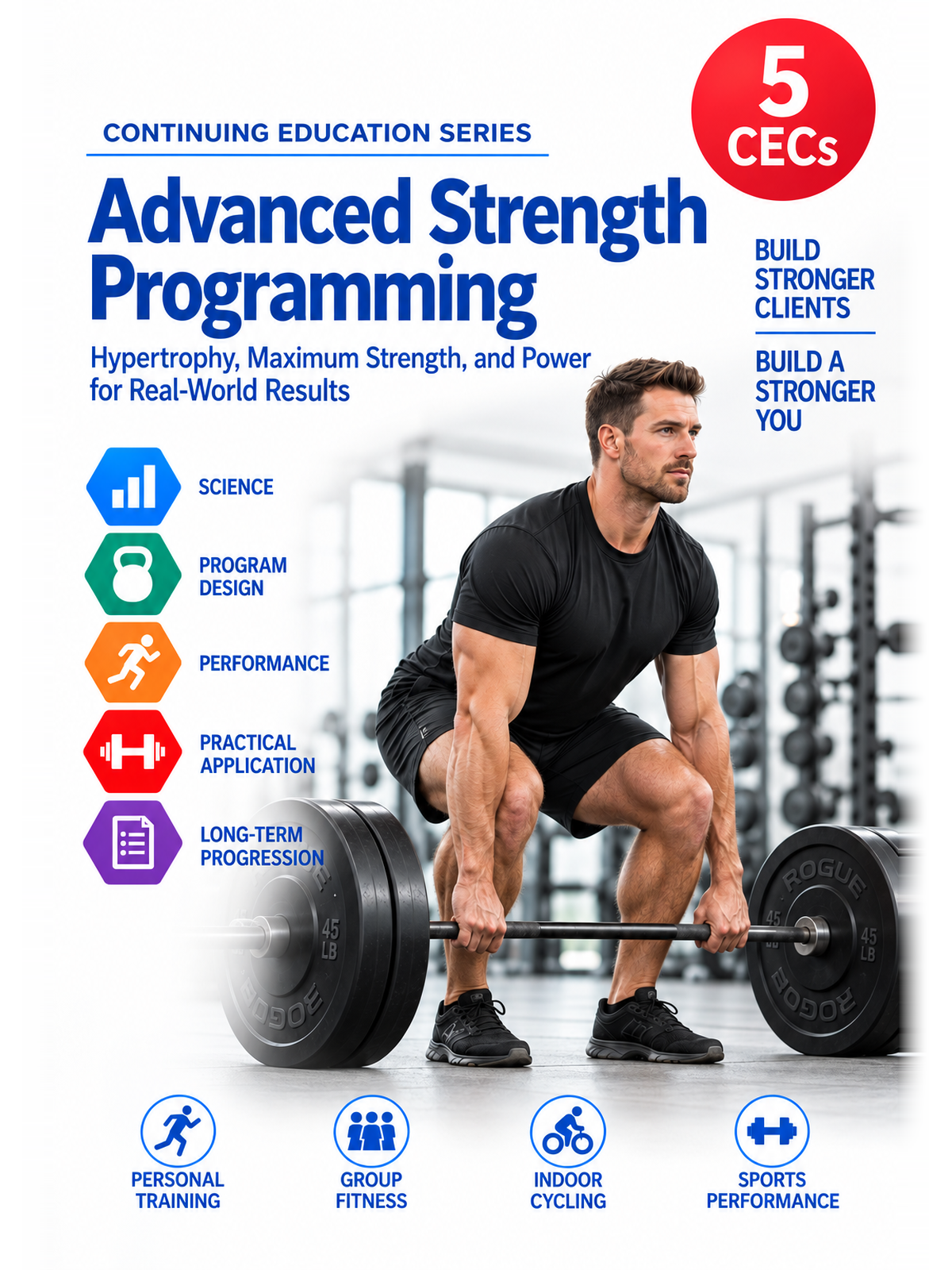
Advanced Strength Programming is a comprehensive 5-CEC continuing education course designed for fitness professionals who want to move beyond basic resistance-training prescriptions and develop a deeper understanding of hypertrophy, maximum strength, power, fatigue management, progression, and long-term program design.
Advanced programming is not defined by complicated exercises or elaborate spreadsheets. It is defined by the quality of the decisions behind the program. As clients become more experienced, simply adding more weight, more sets, more exercises, or more intensity can increase fatigue faster than it improves results.
This course teaches the fitness professional to ask a more useful question:
What training stimulus is needed to produce the desired adaptation, and what is the lowest recovery cost at which that stimulus can be delivered repeatedly?
The course centers on three related but distinct training outcomes:
Hypertrophy — increasing muscle size
Maximum Strength — increasing high-force production
Power — producing force rapidly
The program-design variables used to develop those outcomes include load, volume, frequency, exercise selection, range of motion, proximity to failure, repetition intent, rest intervals, progression, and recovery.
Topics include:
The logic of advanced strength programming
Specificity and progressive overload
Stimulus-to-fatigue relationships
Training age and advanced programming needs
Load, volume, frequency, and effort
Exercise selection and exercise order
Range of motion
Rest intervals
Repetition intent and velocity
Hypertrophy programming
Productive weekly volume
Proximity to failure
Exercise selection for muscle growth
Hypertrophy frequency
Maximum-strength programming
Heavy-load specificity
Primary, secondary, and accessory strength work
Top sets and back-off work
Strength testing and estimated 1RM
Power development
The force–velocity continuum
Jumps and medicine-ball throws
Loaded ballistic training
Olympic-lift derivatives
Velocity-based training
Advanced exercise selection
RIR and RPE
Technical failure versus absolute failure
Autoregulation
Fatigue, readiness, and recovery
Plateau identification
Double progression
Load and volume progression
Power progression
Linear, undulating, and block periodization
Mesocycle design
Deloading, tapering, and transition weeks
Advanced training methods
Drop sets
Rest-pause training
Supersets
Cluster sets
Eccentric overload
Contrast training
Long-term integration of hypertrophy, strength, and power
The NFPA Advanced Strength Programming Process
Course Includes:
5 NFPA Continuing Education Credits
Self-paced PDF course
Advanced resistance-training programming
Hypertrophy, strength, and power applications
Practical mesocycle and periodization examples
Autoregulation and fatigue-management strategies
Advanced training-method guidance
Applied programming examples
Practice Knowledge Check with answer key
Course Code: CEC-ASP-501
Program the adaptation, not the trend.
Hypertrophy, Maximum Strength, and Power
Evidence-Based Program Design for Building Muscle, Increasing Maximum Force, Developing Explosive Performance, and Managing Long-Term Progression
Then paste this full description underneath:
Build more effective strength programs by matching training variables to the adaptation you actually want.
Advanced Strength Programming is a comprehensive 5-CEC continuing education course designed for fitness professionals who want to move beyond basic resistance-training prescriptions and develop a deeper understanding of hypertrophy, maximum strength, power, fatigue management, progression, and long-term program design.
Advanced programming is not defined by complicated exercises or elaborate spreadsheets. It is defined by the quality of the decisions behind the program. As clients become more experienced, simply adding more weight, more sets, more exercises, or more intensity can increase fatigue faster than it improves results.
This course teaches the fitness professional to ask a more useful question:
What training stimulus is needed to produce the desired adaptation, and what is the lowest recovery cost at which that stimulus can be delivered repeatedly?
The course centers on three related but distinct training outcomes:
Hypertrophy — increasing muscle size
Maximum Strength — increasing high-force production
Power — producing force rapidly
The program-design variables used to develop those outcomes include load, volume, frequency, exercise selection, range of motion, proximity to failure, repetition intent, rest intervals, progression, and recovery.
Topics include:
The logic of advanced strength programming
Specificity and progressive overload
Stimulus-to-fatigue relationships
Training age and advanced programming needs
Load, volume, frequency, and effort
Exercise selection and exercise order
Range of motion
Rest intervals
Repetition intent and velocity
Hypertrophy programming
Productive weekly volume
Proximity to failure
Exercise selection for muscle growth
Hypertrophy frequency
Maximum-strength programming
Heavy-load specificity
Primary, secondary, and accessory strength work
Top sets and back-off work
Strength testing and estimated 1RM
Power development
The force–velocity continuum
Jumps and medicine-ball throws
Loaded ballistic training
Olympic-lift derivatives
Velocity-based training
Advanced exercise selection
RIR and RPE
Technical failure versus absolute failure
Autoregulation
Fatigue, readiness, and recovery
Plateau identification
Double progression
Load and volume progression
Power progression
Linear, undulating, and block periodization
Mesocycle design
Deloading, tapering, and transition weeks
Advanced training methods
Drop sets
Rest-pause training
Supersets
Cluster sets
Eccentric overload
Contrast training
Long-term integration of hypertrophy, strength, and power
The NFPA Advanced Strength Programming Process
Course Includes:
5 NFPA Continuing Education Credits
Self-paced PDF course
Advanced resistance-training programming
Hypertrophy, strength, and power applications
Practical mesocycle and periodization examples
Autoregulation and fatigue-management strategies
Advanced training-method guidance
Applied programming examples
Practice Knowledge Check with answer key
Course Code: CEC-ASP-501
Program the adaptation, not the trend.