 Image 1 of 1
Bodyweight Training: Strength and Conditioning
Movement Progressions, Strength, Power, Conditioning, and Program Design
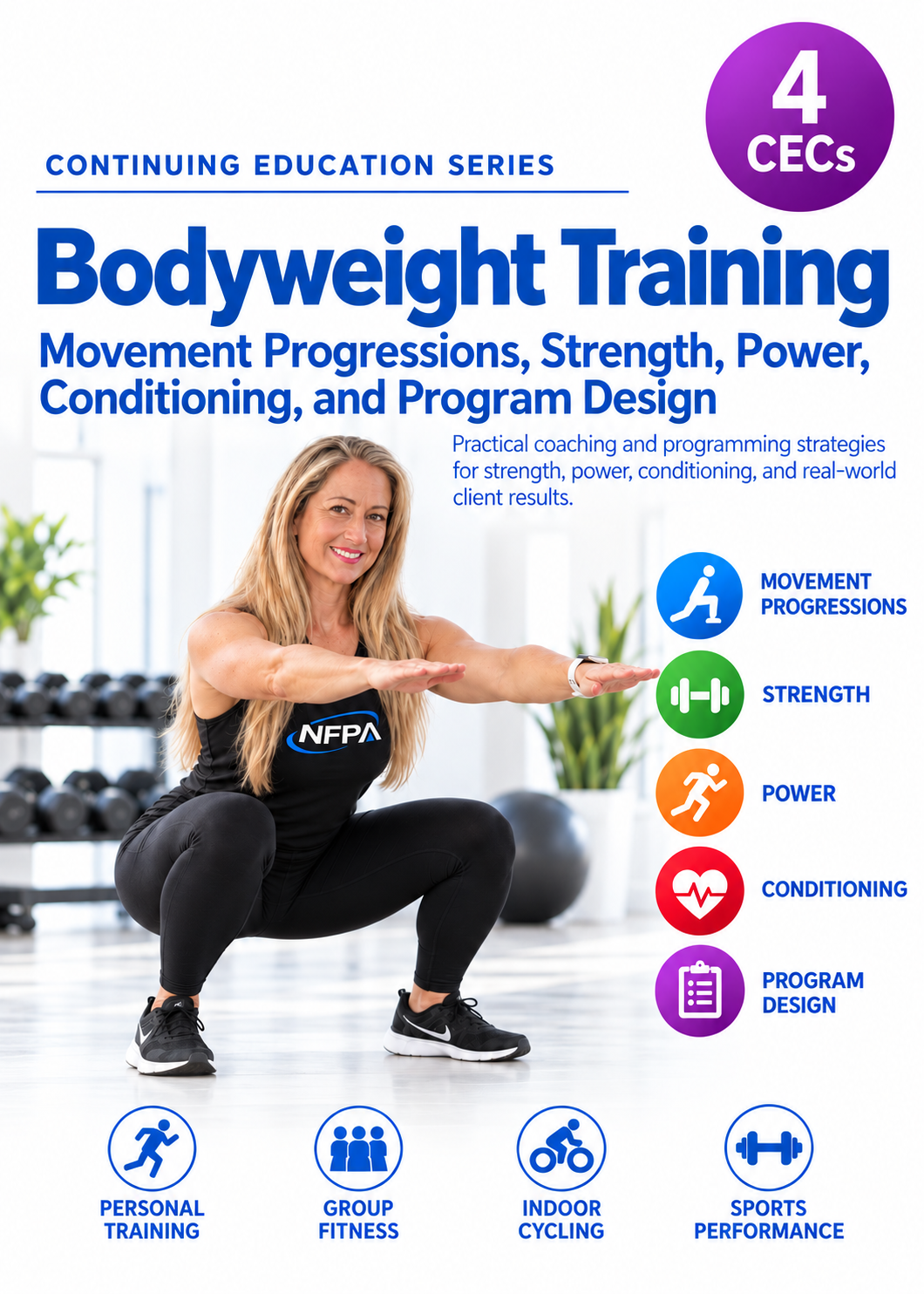
Learn how to build effective bodyweight training programs that develop strength, muscular endurance, power, movement quality, conditioning, and functional fitness through appropriate exercise selection and progressive overload.
Bodyweight Training is a practical 4-CEC continuing education course exploring evidence-informed bodyweight resistance training, exercise techniques, movement progressions, and individualized programming for fitness professionals.
The course examines why bodyweight exercises are not automatically easier than conventional resistance training and how the same exercise can create very different training demands depending on the individual's strength, experience, body proportions, and movement capabilities.
Fitness professionals will learn how leverage, range of motion, assistance, tempo, exercise complexity, base of support, and external resistance can be adjusted to provide an appropriate training stimulus.
Special attention is given to distinguishing exercise difficulty from meaningful overload. Participants will learn why advanced movements are not necessarily superior to simpler exercises and how training methods should be selected according to the desired outcome.
The course also explores bodyweight applications for muscular strength, hypertrophy, endurance, explosive power, plyometrics, cardiovascular conditioning, and functional performance.
Fitness professionals will learn to assess movement capabilities, coach effective exercise variations, manage training volume and recovery, and recognize when external resistance or alternative exercise methods may better serve the client's goals.
Topics Include:
Understanding bodyweight resistance training and calisthenics
The NFPA Bodyweight Training Philosophy
Mechanical loading and exercise difficulty
Progressive overload without conventional weights
Leverage, body position, and mechanical advantage
Base of support and movement stability
Range of motion and exercise progression
Exercise tempo and muscular effort
Repetitions in reserve and training to failure
Recognizing the limitations of bodyweight-only training
Foundational lower-body movement patterns
Squat, sit-to-stand, split squat, and step-up progressions
Hip-hinge patterns, glute bridges, and unilateral exercise
Lunging variations and functional lower-body training
Upper-body pushing and push-up progressions
Upper-body pulling, rows, and assisted pull-ups
Trunk training, bracing, and movement control
Anti-extension, anti-rotation, and lateral stabilization
Programming for muscular strength and hypertrophy
Exercise selection, training volume, and recovery
Muscular endurance and bodyweight work capacity
Circuit training, exercise density, and interval formats
Power development and explosive exercise
Jumping, landing, and plyometric progressions
Differentiating strength, power, and conditioning
Selecting exercises for different fitness objectives
Exercise screening and functional movement observation
Appropriate regression and progression strategies
Bodyweight programming for beginners and older adults
Youth, general-fitness, and athletic training considerations
Home-based and limited-equipment exercise programs
Integrating bodyweight exercises with conventional resistance training
Monitoring exercise performance and client progress
Professional scope of practice and referral
Practical bodyweight training case studies
The NFPA Bodyweight Training Programming Process
Course Includes:
4 NFPA Continuing Education Credits
Self-paced PDF continuing education course
20-question Practice Knowledge Check with answer key and explanations
5 practical case studies covering beginners, advanced exercisers, older adults, athletes, and limited-equipment training
Practical exercise progressions, programming examples, and movement-selection frameworks
Effective bodyweight training is not about choosing the hardest exercise—it is about choosing the right training stimulus for the individual.
Movement Progressions, Strength, Power, Conditioning, and Program Design
Learn how to build effective bodyweight training programs that develop strength, muscular endurance, power, movement quality, conditioning, and functional fitness through appropriate exercise selection and progressive overload.
Bodyweight Training is a practical 4-CEC continuing education course exploring evidence-informed bodyweight resistance training, exercise techniques, movement progressions, and individualized programming for fitness professionals.
The course examines why bodyweight exercises are not automatically easier than conventional resistance training and how the same exercise can create very different training demands depending on the individual's strength, experience, body proportions, and movement capabilities.
Fitness professionals will learn how leverage, range of motion, assistance, tempo, exercise complexity, base of support, and external resistance can be adjusted to provide an appropriate training stimulus.
Special attention is given to distinguishing exercise difficulty from meaningful overload. Participants will learn why advanced movements are not necessarily superior to simpler exercises and how training methods should be selected according to the desired outcome.
The course also explores bodyweight applications for muscular strength, hypertrophy, endurance, explosive power, plyometrics, cardiovascular conditioning, and functional performance.
Fitness professionals will learn to assess movement capabilities, coach effective exercise variations, manage training volume and recovery, and recognize when external resistance or alternative exercise methods may better serve the client's goals.
Topics Include:
Understanding bodyweight resistance training and calisthenics
The NFPA Bodyweight Training Philosophy
Mechanical loading and exercise difficulty
Progressive overload without conventional weights
Leverage, body position, and mechanical advantage
Base of support and movement stability
Range of motion and exercise progression
Exercise tempo and muscular effort
Repetitions in reserve and training to failure
Recognizing the limitations of bodyweight-only training
Foundational lower-body movement patterns
Squat, sit-to-stand, split squat, and step-up progressions
Hip-hinge patterns, glute bridges, and unilateral exercise
Lunging variations and functional lower-body training
Upper-body pushing and push-up progressions
Upper-body pulling, rows, and assisted pull-ups
Trunk training, bracing, and movement control
Anti-extension, anti-rotation, and lateral stabilization
Programming for muscular strength and hypertrophy
Exercise selection, training volume, and recovery
Muscular endurance and bodyweight work capacity
Circuit training, exercise density, and interval formats
Power development and explosive exercise
Jumping, landing, and plyometric progressions
Differentiating strength, power, and conditioning
Selecting exercises for different fitness objectives
Exercise screening and functional movement observation
Appropriate regression and progression strategies
Bodyweight programming for beginners and older adults
Youth, general-fitness, and athletic training considerations
Home-based and limited-equipment exercise programs
Integrating bodyweight exercises with conventional resistance training
Monitoring exercise performance and client progress
Professional scope of practice and referral
Practical bodyweight training case studies
The NFPA Bodyweight Training Programming Process
Course Includes:
4 NFPA Continuing Education Credits
Self-paced PDF continuing education course
20-question Practice Knowledge Check with answer key and explanations
5 practical case studies covering beginners, advanced exercisers, older adults, athletes, and limited-equipment training
Practical exercise progressions, programming examples, and movement-selection frameworks
Effective bodyweight training is not about choosing the hardest exercise—it is about choosing the right training stimulus for the individual.