 Image 1 of 1
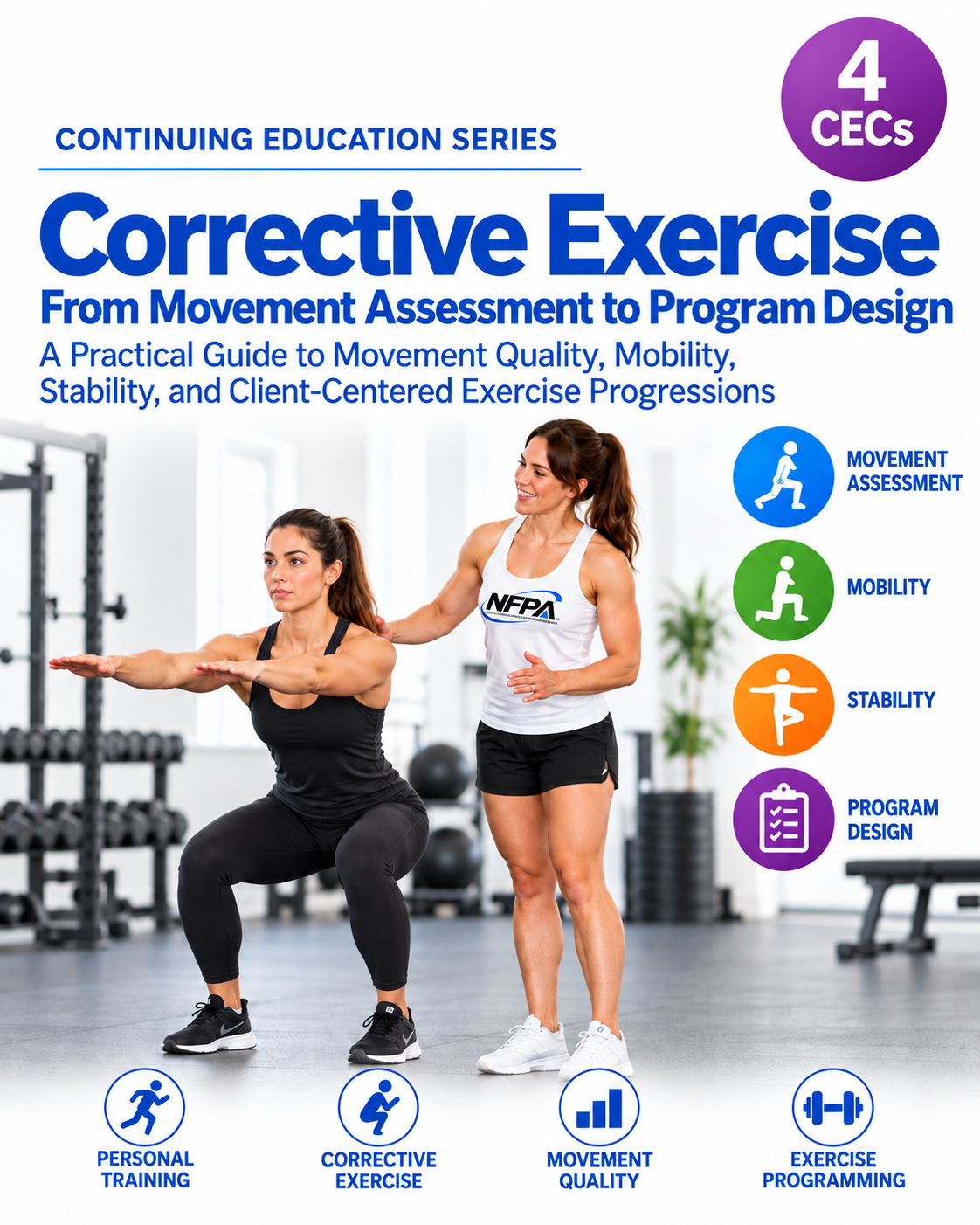
Corrective Exercise Programming
From Movement Assessment to Program Design
Learn how to assess movement, identify meaningful training limitations, and develop effective exercise strategies that improve mobility, stability, strength, coordination, and functional movement capacity.
Corrective Exercise is a practical 4-CEC continuing education course exploring evidence-informed movement assessment, exercise modification, motor control, movement progressions, and individualized programming for fitness professionals.
The course examines corrective exercise as targeted training used to improve movement capacity—not an attempt to identify and repair supposedly defective movement patterns.
Fitness professionals will learn how to observe movement objectively, recognize individual differences, and distinguish limitations involving mobility, strength, balance, coordination, exercise technique, and training experience.
Special attention is given to understanding the appropriate uses and limitations of movement screening. Participants will learn why a single movement assessment cannot reliably predict future injury and why exercise decisions should be based on client goals, symptoms, function, and meaningful training needs.
The course explores practical strategies for assessing squats, hip hinges, lunges, single-leg movements, pushing, pulling, overhead movement, and balance.
Fitness professionals will learn how to apply exercise regressions, progressions, mobility training, strength development, isometric exercises, eccentric loading, movement coaching, and motor-learning principles to improve functional capacity.
The course also emphasizes reassessment, appropriate documentation, professional communication, and recognizing when a client's symptoms require medical evaluation rather than continued fitness intervention.
Topics Include:
Understanding the NFPA corrective exercise philosophy
Corrective exercise as movement-capacity development
Movement observation versus medical diagnosis
Individual movement variability and functional performance
Understanding the limitations of movement screening
Why movement screens cannot reliably predict individual injuries
Client screening, health history, and exercise readiness
Recognizing warning signs and referral concerns
Assessing movement based on client goals
Static posture and its limitations
Squat assessment and movement modifications
Hip-hinge assessment and technique development
Split-squat, lunge, and single-leg movement assessment
Balance assessment and progressive balance training
Upper-body pushing and pulling assessments
Shoulder mechanics and overhead movement
Mobility, flexibility, and usable range of motion
Strength training as a mobility-development strategy
Dynamic mobility, loaded mobility, and stretching
Foam rolling and its appropriate application
Motor control and movement-skill development
Understanding common muscle-activation misconceptions
Core stability, trunk control, and spinal movement
Limitations of the tight-versus-weak model
Posture, muscular imbalance, and corrective exercise myths
Exercise regressions and progressions
Modifying load, range, speed, stability, and complexity
Isometric training and positional control
Eccentric and concentric strength development
Exercise tempo and movement quality
Integrating corrective exercises into normal strength training
Prioritizing assessment findings
Reassessing movement after intervention
Distinguishing immediate improvements from long-term adaptations
Communicating assessment results without fear-based language
Professional documentation and client education
Practical corrective exercise case studies
The NFPA Corrective Exercise Coaching Process
Course Includes:
4 NFPA Continuing Education Credits
Self-paced PDF continuing education course
20-question Practice Knowledge Check with answer key and explanations
10 applied case studies demonstrating movement assessment, exercise modifications, programming decisions, and professional referral
Practical exercise progressions and movement-assessment examples
Evidence-informed strategies for integrating corrective exercise into comprehensive fitness programs
Course Code: CEC-CEX-401
Assess movement capacity. Identify meaningful limitations. Build strength, control, and confidence through purposeful training.
From Movement Assessment to Program Design
Learn how to assess movement, identify meaningful training limitations, and develop effective exercise strategies that improve mobility, stability, strength, coordination, and functional movement capacity.
Corrective Exercise is a practical 4-CEC continuing education course exploring evidence-informed movement assessment, exercise modification, motor control, movement progressions, and individualized programming for fitness professionals.
The course examines corrective exercise as targeted training used to improve movement capacity—not an attempt to identify and repair supposedly defective movement patterns.
Fitness professionals will learn how to observe movement objectively, recognize individual differences, and distinguish limitations involving mobility, strength, balance, coordination, exercise technique, and training experience.
Special attention is given to understanding the appropriate uses and limitations of movement screening. Participants will learn why a single movement assessment cannot reliably predict future injury and why exercise decisions should be based on client goals, symptoms, function, and meaningful training needs.
The course explores practical strategies for assessing squats, hip hinges, lunges, single-leg movements, pushing, pulling, overhead movement, and balance.
Fitness professionals will learn how to apply exercise regressions, progressions, mobility training, strength development, isometric exercises, eccentric loading, movement coaching, and motor-learning principles to improve functional capacity.
The course also emphasizes reassessment, appropriate documentation, professional communication, and recognizing when a client's symptoms require medical evaluation rather than continued fitness intervention.
Topics Include:
Understanding the NFPA corrective exercise philosophy
Corrective exercise as movement-capacity development
Movement observation versus medical diagnosis
Individual movement variability and functional performance
Understanding the limitations of movement screening
Why movement screens cannot reliably predict individual injuries
Client screening, health history, and exercise readiness
Recognizing warning signs and referral concerns
Assessing movement based on client goals
Static posture and its limitations
Squat assessment and movement modifications
Hip-hinge assessment and technique development
Split-squat, lunge, and single-leg movement assessment
Balance assessment and progressive balance training
Upper-body pushing and pulling assessments
Shoulder mechanics and overhead movement
Mobility, flexibility, and usable range of motion
Strength training as a mobility-development strategy
Dynamic mobility, loaded mobility, and stretching
Foam rolling and its appropriate application
Motor control and movement-skill development
Understanding common muscle-activation misconceptions
Core stability, trunk control, and spinal movement
Limitations of the tight-versus-weak model
Posture, muscular imbalance, and corrective exercise myths
Exercise regressions and progressions
Modifying load, range, speed, stability, and complexity
Isometric training and positional control
Eccentric and concentric strength development
Exercise tempo and movement quality
Integrating corrective exercises into normal strength training
Prioritizing assessment findings
Reassessing movement after intervention
Distinguishing immediate improvements from long-term adaptations
Communicating assessment results without fear-based language
Professional documentation and client education
Practical corrective exercise case studies
The NFPA Corrective Exercise Coaching Process
Course Includes:
4 NFPA Continuing Education Credits
Self-paced PDF continuing education course
20-question Practice Knowledge Check with answer key and explanations
10 applied case studies demonstrating movement assessment, exercise modifications, programming decisions, and professional referral
Practical exercise progressions and movement-assessment examples
Evidence-informed strategies for integrating corrective exercise into comprehensive fitness programs
Course Code: CEC-CEX-401
Assess movement capacity. Identify meaningful limitations. Build strength, control, and confidence through purposeful training.