 Image 1 of 1
Endurance Training: Aerobic Capacity and Threshold
Building Aerobic Capacity, Threshold, and Performance
Learn how to develop effective endurance-training programs that improve aerobic capacity, sustainable exercise performance, movement economy, fatigue resistance, and recovery through evidence-informed training methods.
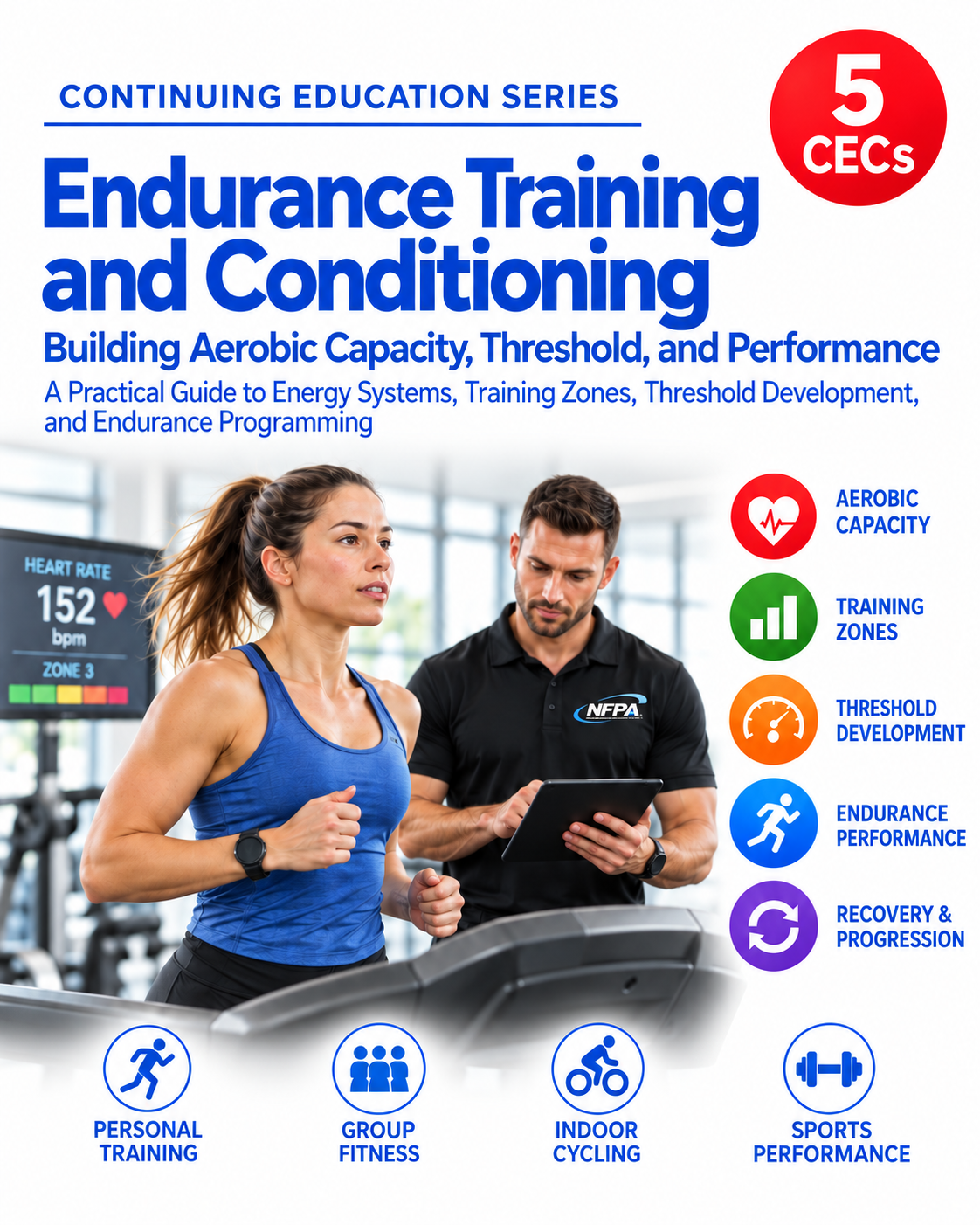
Endurance Training and Conditioning is a comprehensive 5-CEC continuing education course exploring the physiological foundations of endurance performance and the practical application of aerobic conditioning, threshold development, interval training, and individualized exercise programming.
The course examines why endurance training involves much more than simply performing additional cardiovascular exercise. Fitness professionals will learn how maximal oxygen uptake (VO₂max), sustainable threshold characteristics, movement economy, and durability interact to determine endurance performance.
Special attention is given to understanding exercise intensity and the limitations of traditional heart-rate zones. Participants will learn why the term Zone 2 can describe different physiological intensities depending on the training-zone model and why exercise intensity should be prescribed according to the intended adaptation rather than an arbitrary number.
The course explores central and peripheral aerobic adaptations, including changes in cardiac output, blood volume, capillary development, mitochondrial content, and muscular oxidative capacity.
Fitness professionals will learn how to establish an aerobic base, develop threshold performance, integrate high-intensity intervals, and select appropriate training-intensity distributions.
Participants will also explore polarized, pyramidal, and threshold-oriented training approaches, with an emphasis on why no single distribution is universally superior for every athlete or fitness client.
The course provides practical programming examples for beginning exercisers, recreational runners, cyclists, and experienced endurance athletes, while emphasizing progressive overload, fatigue management, strength training, recovery, and professional scope of practice.
Topics Include:
Understanding endurance beyond traditional cardiovascular exercise
VO₂max and maximal aerobic capacity
Sustainable threshold characteristics
Movement economy and efficiency
Durability and resistance to fatigue
Central cardiovascular adaptations to endurance exercise
Stroke volume, blood volume, and oxygen delivery
Mitochondrial adaptations and oxidative capacity
Skeletal-muscle capillarization and oxygen extraction
Understanding physiological exercise-intensity domains
Moderate, heavy, and severe exercise intensities
Heart-rate monitoring and its limitations
Rating of Perceived Exertion (RPE)
Talk Test applications in aerobic training
Pace and power monitoring
Combining internal and external training-load measures
Understanding three-zone and five-zone training models
Why Zone 2 does not mean the same thing in every system
Low-intensity aerobic exercise and endurance development
Building aerobic frequency, duration, and volume
Establishing a sustainable aerobic base
Long-duration aerobic training
Threshold training and sustainable high aerobic workloads
Continuous tempo workouts and cruise intervals
VO₂max-oriented interval training
High-intensity interval training (HIIT)
Work-to-recovery interval manipulation
Sprint interval training versus aerobic HIIT
Pyramidal training-intensity distribution
Polarized training-intensity distribution
Threshold-oriented training models
Selecting training distributions according to athlete level
Why recreational athletes should not automatically copy elite programs
Developing running economy and cycling efficiency
Integrating strength and power training into endurance programs
Monitoring accumulated fatigue and recovery
Heart-rate drift, performance changes, and training tolerance
Progressive endurance-training overload
Periodization and seasonal endurance development
Event-specific training and tapering
Endurance programming for beginners and experienced athletes
Cardiorespiratory training across running, cycling, rowing, and other modalities
Practical endurance-training coaching scenarios
The NFPA Endurance Programming Process
Course Includes:
5 NFPA Continuing Education Credits
Self-paced PDF continuing education course
25-question Practice Knowledge Check with answer key and explanations
4 integrated coaching cases involving training-zone interpretation, HIIT programming, VO₂max, and endurance-training distributions
4 detailed endurance program examples for beginner fitness, recreational running, recreational cycling, and experienced athletes
Practical training-zone interpretation, threshold workouts, interval prescriptions, and progression strategies
Evidence-informed guidance for monitoring training load, recovery, and endurance performance
Course Code: CEC-ETC-501
Build the capacity. Sustain the work. Recover and repeat.
Building Aerobic Capacity, Threshold, and Performance
Learn how to develop effective endurance-training programs that improve aerobic capacity, sustainable exercise performance, movement economy, fatigue resistance, and recovery through evidence-informed training methods.
Endurance Training and Conditioning is a comprehensive 5-CEC continuing education course exploring the physiological foundations of endurance performance and the practical application of aerobic conditioning, threshold development, interval training, and individualized exercise programming.
The course examines why endurance training involves much more than simply performing additional cardiovascular exercise. Fitness professionals will learn how maximal oxygen uptake (VO₂max), sustainable threshold characteristics, movement economy, and durability interact to determine endurance performance.
Special attention is given to understanding exercise intensity and the limitations of traditional heart-rate zones. Participants will learn why the term Zone 2 can describe different physiological intensities depending on the training-zone model and why exercise intensity should be prescribed according to the intended adaptation rather than an arbitrary number.
The course explores central and peripheral aerobic adaptations, including changes in cardiac output, blood volume, capillary development, mitochondrial content, and muscular oxidative capacity.
Fitness professionals will learn how to establish an aerobic base, develop threshold performance, integrate high-intensity intervals, and select appropriate training-intensity distributions.
Participants will also explore polarized, pyramidal, and threshold-oriented training approaches, with an emphasis on why no single distribution is universally superior for every athlete or fitness client.
The course provides practical programming examples for beginning exercisers, recreational runners, cyclists, and experienced endurance athletes, while emphasizing progressive overload, fatigue management, strength training, recovery, and professional scope of practice.
Topics Include:
Understanding endurance beyond traditional cardiovascular exercise
VO₂max and maximal aerobic capacity
Sustainable threshold characteristics
Movement economy and efficiency
Durability and resistance to fatigue
Central cardiovascular adaptations to endurance exercise
Stroke volume, blood volume, and oxygen delivery
Mitochondrial adaptations and oxidative capacity
Skeletal-muscle capillarization and oxygen extraction
Understanding physiological exercise-intensity domains
Moderate, heavy, and severe exercise intensities
Heart-rate monitoring and its limitations
Rating of Perceived Exertion (RPE)
Talk Test applications in aerobic training
Pace and power monitoring
Combining internal and external training-load measures
Understanding three-zone and five-zone training models
Why Zone 2 does not mean the same thing in every system
Low-intensity aerobic exercise and endurance development
Building aerobic frequency, duration, and volume
Establishing a sustainable aerobic base
Long-duration aerobic training
Threshold training and sustainable high aerobic workloads
Continuous tempo workouts and cruise intervals
VO₂max-oriented interval training
High-intensity interval training (HIIT)
Work-to-recovery interval manipulation
Sprint interval training versus aerobic HIIT
Pyramidal training-intensity distribution
Polarized training-intensity distribution
Threshold-oriented training models
Selecting training distributions according to athlete level
Why recreational athletes should not automatically copy elite programs
Developing running economy and cycling efficiency
Integrating strength and power training into endurance programs
Monitoring accumulated fatigue and recovery
Heart-rate drift, performance changes, and training tolerance
Progressive endurance-training overload
Periodization and seasonal endurance development
Event-specific training and tapering
Endurance programming for beginners and experienced athletes
Cardiorespiratory training across running, cycling, rowing, and other modalities
Practical endurance-training coaching scenarios
The NFPA Endurance Programming Process
Course Includes:
5 NFPA Continuing Education Credits
Self-paced PDF continuing education course
25-question Practice Knowledge Check with answer key and explanations
4 integrated coaching cases involving training-zone interpretation, HIIT programming, VO₂max, and endurance-training distributions
4 detailed endurance program examples for beginner fitness, recreational running, recreational cycling, and experienced athletes
Practical training-zone interpretation, threshold workouts, interval prescriptions, and progression strategies
Evidence-informed guidance for monitoring training load, recovery, and endurance performance
Course Code: CEC-ETC-501
Build the capacity. Sustain the work. Recover and repeat.