 Image 1 of 1
Fall Prevention: Balance, Strength, and Power
Balance, Strength, and Power for Older Adults
Learn how to design safe, effective, and progressive exercise programs that help older adults improve balance, strength, muscular power, mobility, confidence, and the physical capacities associated with reducing fall risk.
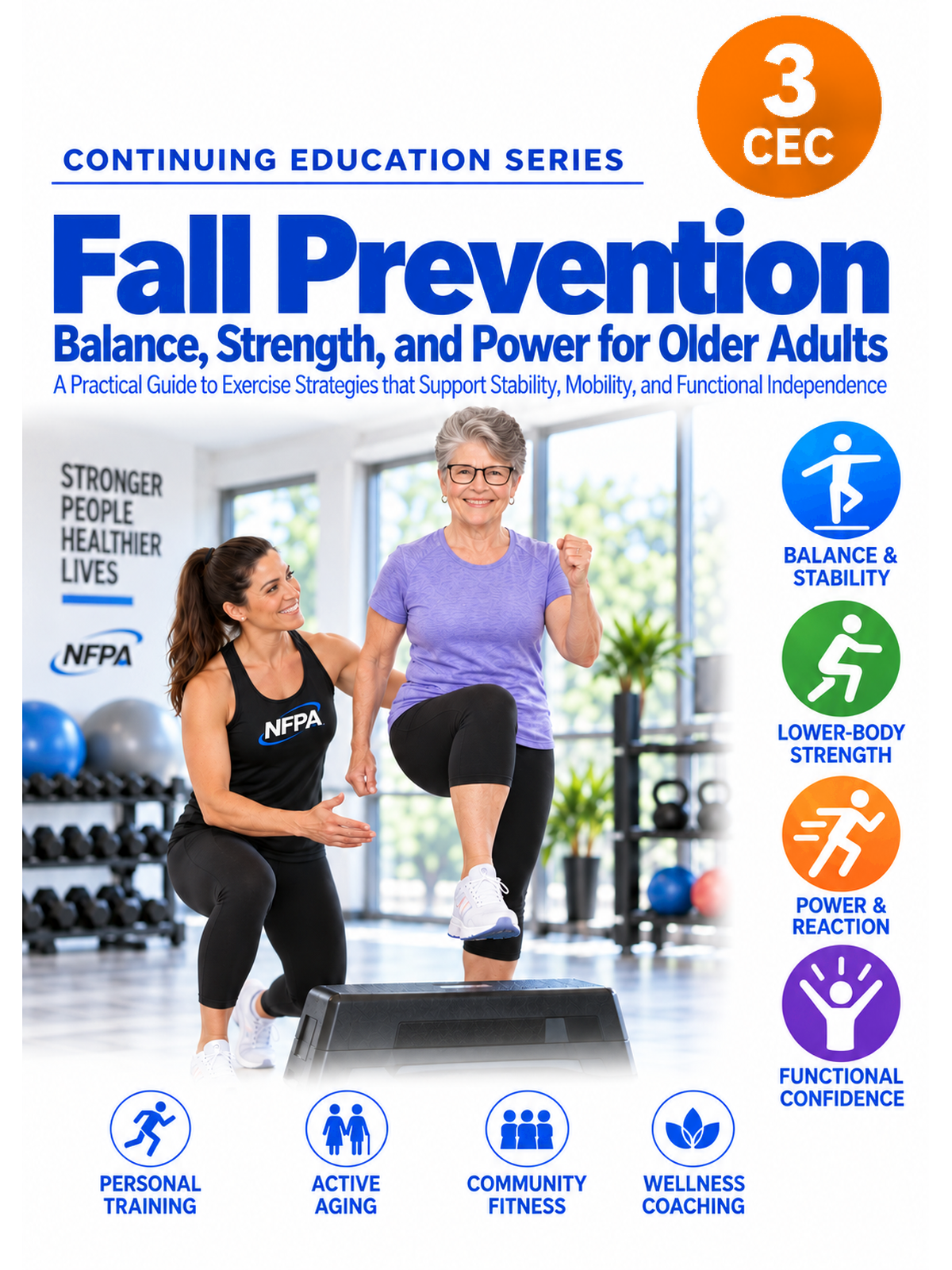
Fall Prevention: Balance, Strength, and Power for Older Adults is a practical 3-CEC continuing education course exploring evidence-informed fall-risk-reduction strategies, functional assessment, balance training, resistance exercise, and individualized programming for older adults.
The course examines why falls become more common with age without treating falling as inevitable. Fitness professionals will learn how physical capacity, sensory input, reaction speed, medication effects, environmental hazards, and underlying health conditions can interact to influence fall risk.
Special attention is given to understanding static, dynamic, anticipatory, and reactive balance; improving gait and stepping responses; and developing the lower-body strength and muscular power needed for everyday activities and balance recovery.
Fitness professionals will learn how to use functional assessments, implement progressively challenging but controlled exercises, and integrate strength, power, balance, mobility, and aerobic conditioning into comprehensive programs.
The course also emphasizes recognizing warning signs, coordinating with healthcare providers when appropriate, and respecting the distinction between fitness programming and clinical fall-risk evaluation.
Topics Include:
Understanding falls and fall-risk factors in older adults
Why falling is not an inevitable consequence of aging
Intrinsic and extrinsic contributors to fall risk
Fear of falling, reduced activity, and deconditioning
Center of mass and base of support
Visual, vestibular, and somatosensory contributions to balance
Static, dynamic, anticipatory, and reactive balance
Ankle, hip, stepping, and grasping recovery strategies
Walking mechanics, turning, and directional changes
Foot clearance and obstacle negotiation
Lateral, backward, and multidirectional stepping
The relationship between strength, power, and balance recovery
Progressive resistance training for older adults
Sit-to-stand, squats, step-ups, calf raises, and functional strength
Safe power-oriented exercise progressions
Screening fall history and identifying referral concerns
Timed Up and Go (TUG) assessment
30-Second Chair Stand assessment
4-Stage Balance Test
Progressive balance-training techniques
Adjusting hand support, stance width, movement, and task complexity
Conservative reactive-balance and recovery-stepping exercises
Dual-task exercise and cognitive-motor challenges
Integrating balance, strength, power, mobility, and aerobic exercise
Tai chi and other balance-training approaches
Designing individualized and group fall-risk-reduction programs
Fall-risk considerations involving osteoporosis, arthritis, joint replacement, and mobility limitations
Medication, blood-pressure, sensory, and neurological referral considerations
Beginner, intermediate, and higher-risk client programming
Practical fall-prevention coaching scenarios
The NFPA Fall Prevention Coaching Process
Course Includes:
3 NFPA Continuing Education Credits
Self-paced PDF continuing education course
15-question Practice Knowledge Check with answer key and explanations
8 practical coaching cases involving balance, strength, fall history, confidence, functional movement, and referral
Sample 12-week progressive fall-risk-reduction exercise program
Practical balance, strength, muscular power, gait, and stepping progressions
Course Code: CEC-FP-301
Train the capacity to stay upright—and the capacity to recover when balance is lost.
Balance, Strength, and Power for Older Adults
Learn how to design safe, effective, and progressive exercise programs that help older adults improve balance, strength, muscular power, mobility, confidence, and the physical capacities associated with reducing fall risk.
Fall Prevention: Balance, Strength, and Power for Older Adults is a practical 3-CEC continuing education course exploring evidence-informed fall-risk-reduction strategies, functional assessment, balance training, resistance exercise, and individualized programming for older adults.
The course examines why falls become more common with age without treating falling as inevitable. Fitness professionals will learn how physical capacity, sensory input, reaction speed, medication effects, environmental hazards, and underlying health conditions can interact to influence fall risk.
Special attention is given to understanding static, dynamic, anticipatory, and reactive balance; improving gait and stepping responses; and developing the lower-body strength and muscular power needed for everyday activities and balance recovery.
Fitness professionals will learn how to use functional assessments, implement progressively challenging but controlled exercises, and integrate strength, power, balance, mobility, and aerobic conditioning into comprehensive programs.
The course also emphasizes recognizing warning signs, coordinating with healthcare providers when appropriate, and respecting the distinction between fitness programming and clinical fall-risk evaluation.
Topics Include:
Understanding falls and fall-risk factors in older adults
Why falling is not an inevitable consequence of aging
Intrinsic and extrinsic contributors to fall risk
Fear of falling, reduced activity, and deconditioning
Center of mass and base of support
Visual, vestibular, and somatosensory contributions to balance
Static, dynamic, anticipatory, and reactive balance
Ankle, hip, stepping, and grasping recovery strategies
Walking mechanics, turning, and directional changes
Foot clearance and obstacle negotiation
Lateral, backward, and multidirectional stepping
The relationship between strength, power, and balance recovery
Progressive resistance training for older adults
Sit-to-stand, squats, step-ups, calf raises, and functional strength
Safe power-oriented exercise progressions
Screening fall history and identifying referral concerns
Timed Up and Go (TUG) assessment
30-Second Chair Stand assessment
4-Stage Balance Test
Progressive balance-training techniques
Adjusting hand support, stance width, movement, and task complexity
Conservative reactive-balance and recovery-stepping exercises
Dual-task exercise and cognitive-motor challenges
Integrating balance, strength, power, mobility, and aerobic exercise
Tai chi and other balance-training approaches
Designing individualized and group fall-risk-reduction programs
Fall-risk considerations involving osteoporosis, arthritis, joint replacement, and mobility limitations
Medication, blood-pressure, sensory, and neurological referral considerations
Beginner, intermediate, and higher-risk client programming
Practical fall-prevention coaching scenarios
The NFPA Fall Prevention Coaching Process
Course Includes:
3 NFPA Continuing Education Credits
Self-paced PDF continuing education course
15-question Practice Knowledge Check with answer key and explanations
8 practical coaching cases involving balance, strength, fall history, confidence, functional movement, and referral
Sample 12-week progressive fall-risk-reduction exercise program
Practical balance, strength, muscular power, gait, and stepping progressions
Course Code: CEC-FP-301
Train the capacity to stay upright—and the capacity to recover when balance is lost.