 Image 1 of 1
Fitness Assessment & Testing
Assessment Selection, Administration, Interpretation, and Program Application
Learn how to select, administer, interpret, and apply fitness assessments that provide meaningful information for exercise programming, client progress, and professional decision-making.
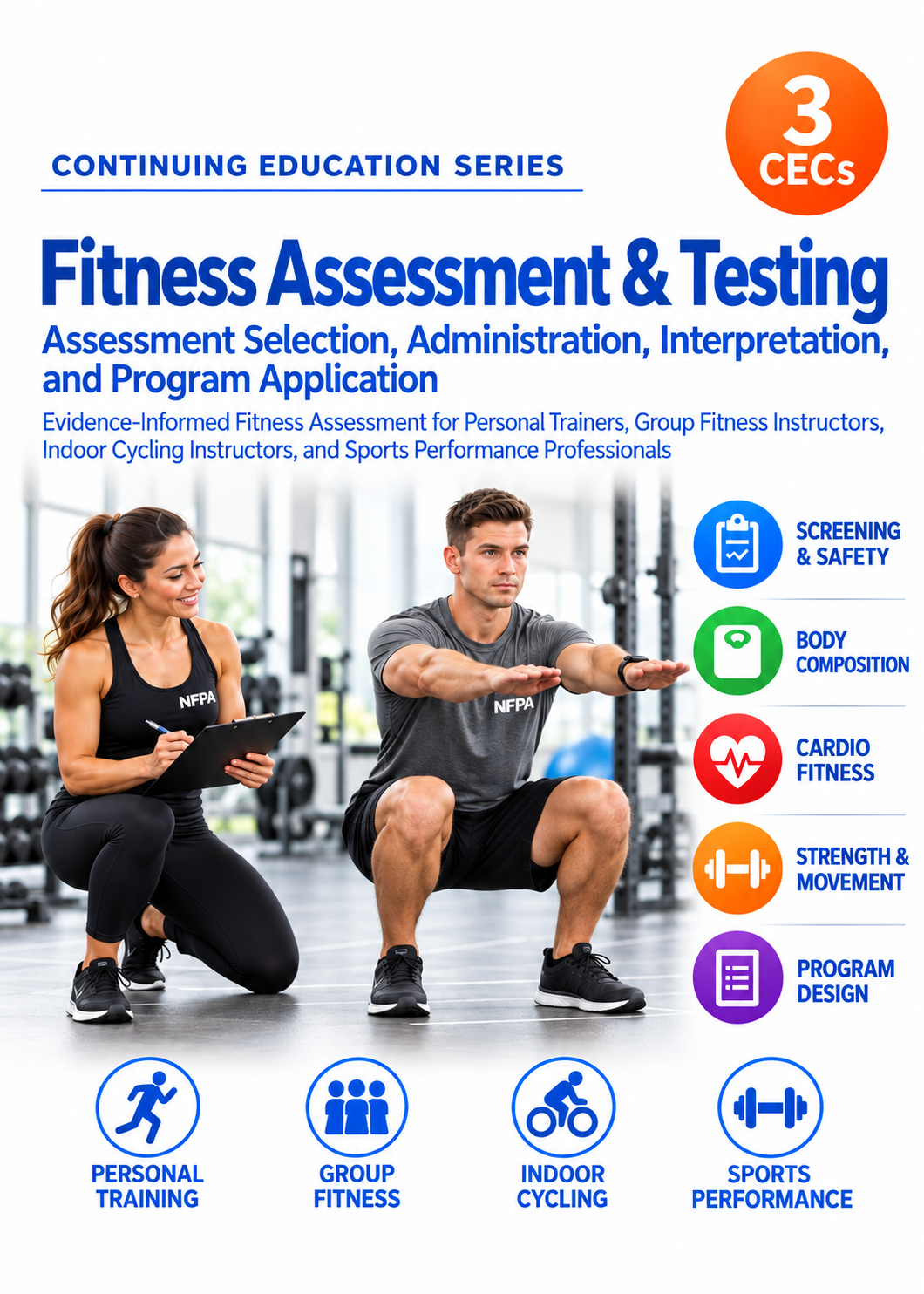
Fitness Assessment & Testing is a practical 3-CEC continuing education course exploring evidence-informed assessment methods for personal trainers, group fitness instructors, indoor cycling instructors, and sports performance professionals.
The course examines why effective fitness assessment begins with a specific client goal or coaching question—not simply collecting measurements. Fitness professionals will learn how to choose appropriate tests based on client needs, health status, experience, equipment, safety, and practical usefulness.
Special attention is given to assessment validity, reliability, testing standardization, biological variability, and measurement error. The course explains why assessment results must be interpreted in context rather than treated as perfectly precise measures of fitness or health.
Fitness professionals will explore common methods of body-composition assessment, cardiorespiratory testing, muscular strength and endurance testing, power assessment, movement observation, flexibility, mobility, and functional performance.
The course also emphasizes informed consent, client privacy, appropriate testing frequency, recognizing signs that require test termination, and distinguishing fitness assessment from medical diagnosis.
Participants will learn how to translate assessment findings into meaningful exercise selection, training intensity, progression, reassessment, and referral decisions.
Topics Include:
The NFPA philosophy of evidence-informed fitness assessment
Selecting assessments based on client goals and coaching questions
Screening, assessment, testing, observation, and diagnosis
Validity, reliability, objectivity, and sensitivity to change
Floor effects, ceiling effects, and test specificity
Testing standardization and biological variability
Measurement error and meaningful interpretation
Pre-test preparation, client communication, and testing order
Resting heart rate and blood-pressure measurement
Test safety, termination criteria, and referral considerations
Body mass, BMI, and circumference measurements
Skinfold testing and body-composition estimates
Bioelectrical impedance analysis (BIA)
Body-composition testing limitations and client consent
Direct versus estimated cardiorespiratory fitness
Maximal, submaximal, and field-based aerobic testing
Walking, cycling, treadmill, running, and step-test protocols
Heart rate, RPE, and the Talk Test
One-repetition maximum (1RM) strength testing
Multiple-repetition maximum and estimated strength testing
Muscular endurance and standardized repetition tests
Vertical jump and other muscular power assessments
Movement observation, flexibility, and mobility testing
Balance, gait, and functional performance
Interpreting results using goals, baseline data, and appropriate norms
Distinguishing measurement variability from meaningful progress
Designing efficient assessment batteries
Reassessment schedules and progress monitoring
Translating assessment results into individualized exercise programs
Professional scope of practice and appropriate referral
Practical fitness assessment case studies
The NFPA Fitness Assessment & Testing Process
Course Includes:
3 NFPA Continuing Education Credits
Self-paced PDF continuing education course
15-question Practice Knowledge Check with answer key and explanations
8 applied case studies involving assessment selection, testing limitations, client communication, and program application
Practical assessment-selection frameworks, testing procedures, and interpretation examples
Course Code: CEC-FAT-301
Test what matters. Interpret what the test actually measures. Use the results to make better programming decisions.
Assessment Selection, Administration, Interpretation, and Program Application
Learn how to select, administer, interpret, and apply fitness assessments that provide meaningful information for exercise programming, client progress, and professional decision-making.
Fitness Assessment & Testing is a practical 3-CEC continuing education course exploring evidence-informed assessment methods for personal trainers, group fitness instructors, indoor cycling instructors, and sports performance professionals.
The course examines why effective fitness assessment begins with a specific client goal or coaching question—not simply collecting measurements. Fitness professionals will learn how to choose appropriate tests based on client needs, health status, experience, equipment, safety, and practical usefulness.
Special attention is given to assessment validity, reliability, testing standardization, biological variability, and measurement error. The course explains why assessment results must be interpreted in context rather than treated as perfectly precise measures of fitness or health.
Fitness professionals will explore common methods of body-composition assessment, cardiorespiratory testing, muscular strength and endurance testing, power assessment, movement observation, flexibility, mobility, and functional performance.
The course also emphasizes informed consent, client privacy, appropriate testing frequency, recognizing signs that require test termination, and distinguishing fitness assessment from medical diagnosis.
Participants will learn how to translate assessment findings into meaningful exercise selection, training intensity, progression, reassessment, and referral decisions.
Topics Include:
The NFPA philosophy of evidence-informed fitness assessment
Selecting assessments based on client goals and coaching questions
Screening, assessment, testing, observation, and diagnosis
Validity, reliability, objectivity, and sensitivity to change
Floor effects, ceiling effects, and test specificity
Testing standardization and biological variability
Measurement error and meaningful interpretation
Pre-test preparation, client communication, and testing order
Resting heart rate and blood-pressure measurement
Test safety, termination criteria, and referral considerations
Body mass, BMI, and circumference measurements
Skinfold testing and body-composition estimates
Bioelectrical impedance analysis (BIA)
Body-composition testing limitations and client consent
Direct versus estimated cardiorespiratory fitness
Maximal, submaximal, and field-based aerobic testing
Walking, cycling, treadmill, running, and step-test protocols
Heart rate, RPE, and the Talk Test
One-repetition maximum (1RM) strength testing
Multiple-repetition maximum and estimated strength testing
Muscular endurance and standardized repetition tests
Vertical jump and other muscular power assessments
Movement observation, flexibility, and mobility testing
Balance, gait, and functional performance
Interpreting results using goals, baseline data, and appropriate norms
Distinguishing measurement variability from meaningful progress
Designing efficient assessment batteries
Reassessment schedules and progress monitoring
Translating assessment results into individualized exercise programs
Professional scope of practice and appropriate referral
Practical fitness assessment case studies
The NFPA Fitness Assessment & Testing Process
Course Includes:
3 NFPA Continuing Education Credits
Self-paced PDF continuing education course
15-question Practice Knowledge Check with answer key and explanations
8 applied case studies involving assessment selection, testing limitations, client communication, and program application
Practical assessment-selection frameworks, testing procedures, and interpretation examples
Course Code: CEC-FAT-301
Test what matters. Interpret what the test actually measures. Use the results to make better programming decisions.