 Image 1 of 1
Evidence, Technique, and Practical Application
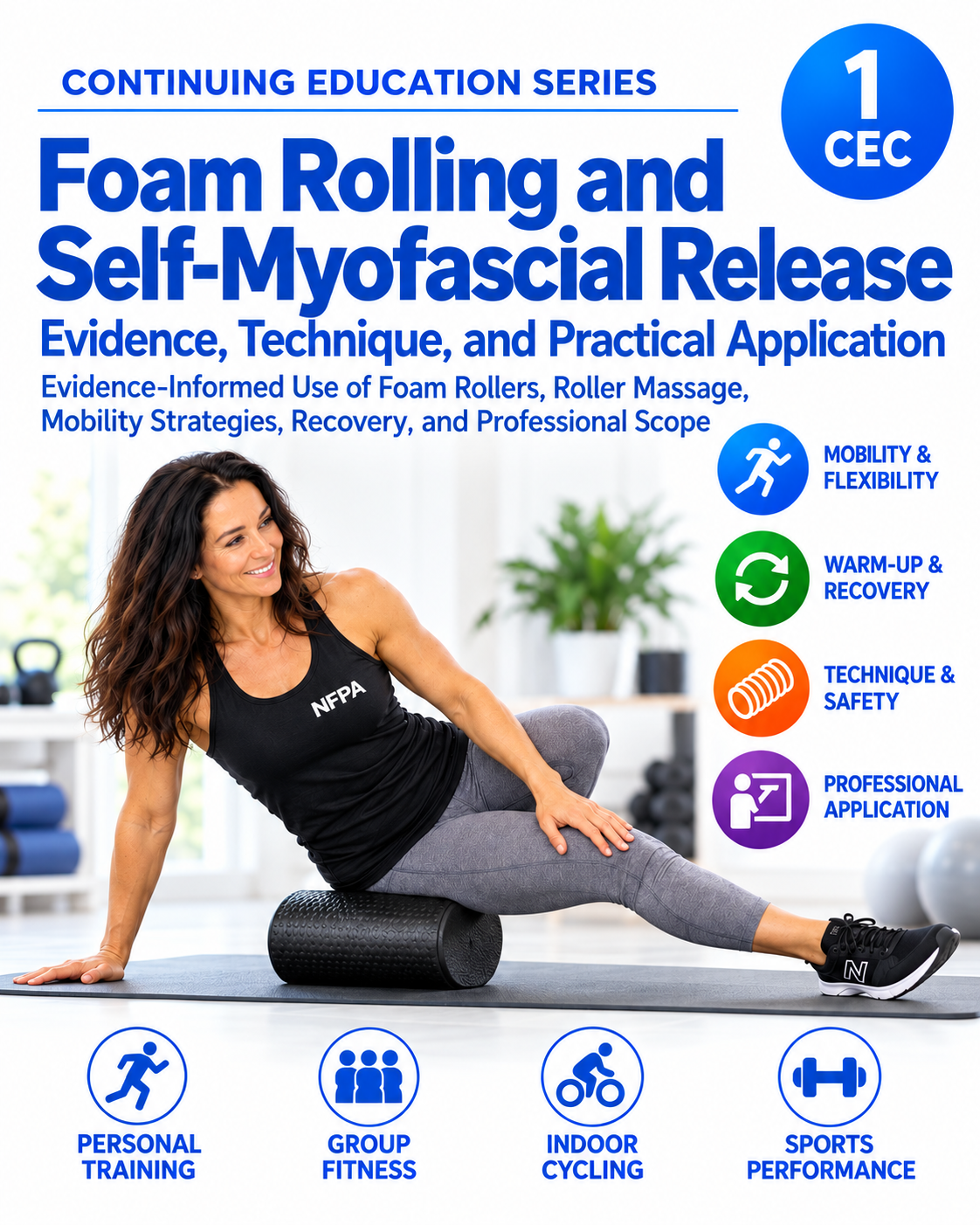
Learn how to use foam rolling and self-myofascial release (SMR) effectively, safely, and in accordance with current research—without relying on exaggerated claims about fascia, muscle knots, or tissue release.
Foam Rolling and Self-Myofascial Release is a practical 1-CEC continuing education course that explores evidence-informed techniques for improving range of motion, supporting warm-ups, managing perceived muscle soreness, and integrating foam rolling into fitness programming.
The course examines appropriate pressure, duration, body positioning, muscle selection, safety considerations, and professional boundaries. Fitness professionals will learn when foam rolling may be beneficial, when other mobility strategies may be more appropriate, and how to evaluate client responses.
Topics Include:
Understanding foam rolling and self-myofascial release
Research-supported benefits and common misconceptions
Acute range-of-motion improvements and flexibility
Foam rolling as part of an effective warm-up
Appropriate pressure, duration, and technique
Practical applications for calves, quadriceps, hamstrings, glutes, and upper back
Iliotibial band myths and vulnerable anatomical structures
Post-exercise soreness and recovery considerations
Foam rolling versus stretching
Contraindications, safety, and professional referral
Applied client scenarios and coaching strategies
The NFPA Foam Rolling Process
Course Includes:
1 NFPA Continuing Education Credit
Self-paced PDF course
5-question Practice Knowledge Check with answer key and explanations
Professional application examples and coaching scenarios
Course Code: CEC-FR-101
Roll to improve the response—not to punish the tissue.
Evidence, Technique, and Practical Application
Learn how to use foam rolling and self-myofascial release (SMR) effectively, safely, and in accordance with current research—without relying on exaggerated claims about fascia, muscle knots, or tissue release.
Foam Rolling and Self-Myofascial Release is a practical 1-CEC continuing education course that explores evidence-informed techniques for improving range of motion, supporting warm-ups, managing perceived muscle soreness, and integrating foam rolling into fitness programming.
The course examines appropriate pressure, duration, body positioning, muscle selection, safety considerations, and professional boundaries. Fitness professionals will learn when foam rolling may be beneficial, when other mobility strategies may be more appropriate, and how to evaluate client responses.
Topics Include:
Understanding foam rolling and self-myofascial release
Research-supported benefits and common misconceptions
Acute range-of-motion improvements and flexibility
Foam rolling as part of an effective warm-up
Appropriate pressure, duration, and technique
Practical applications for calves, quadriceps, hamstrings, glutes, and upper back
Iliotibial band myths and vulnerable anatomical structures
Post-exercise soreness and recovery considerations
Foam rolling versus stretching
Contraindications, safety, and professional referral
Applied client scenarios and coaching strategies
The NFPA Foam Rolling Process
Course Includes:
1 NFPA Continuing Education Credit
Self-paced PDF course
5-question Practice Knowledge Check with answer key and explanations
Professional application examples and coaching scenarios
Course Code: CEC-FR-101
Roll to improve the response—not to punish the tissue.