 Image 1 of 1
From Resting HR to Threshold-Based Programming
Learn how to use heart rate as a practical coaching tool without treating a number, formula, zone, or wearable device as absolute.
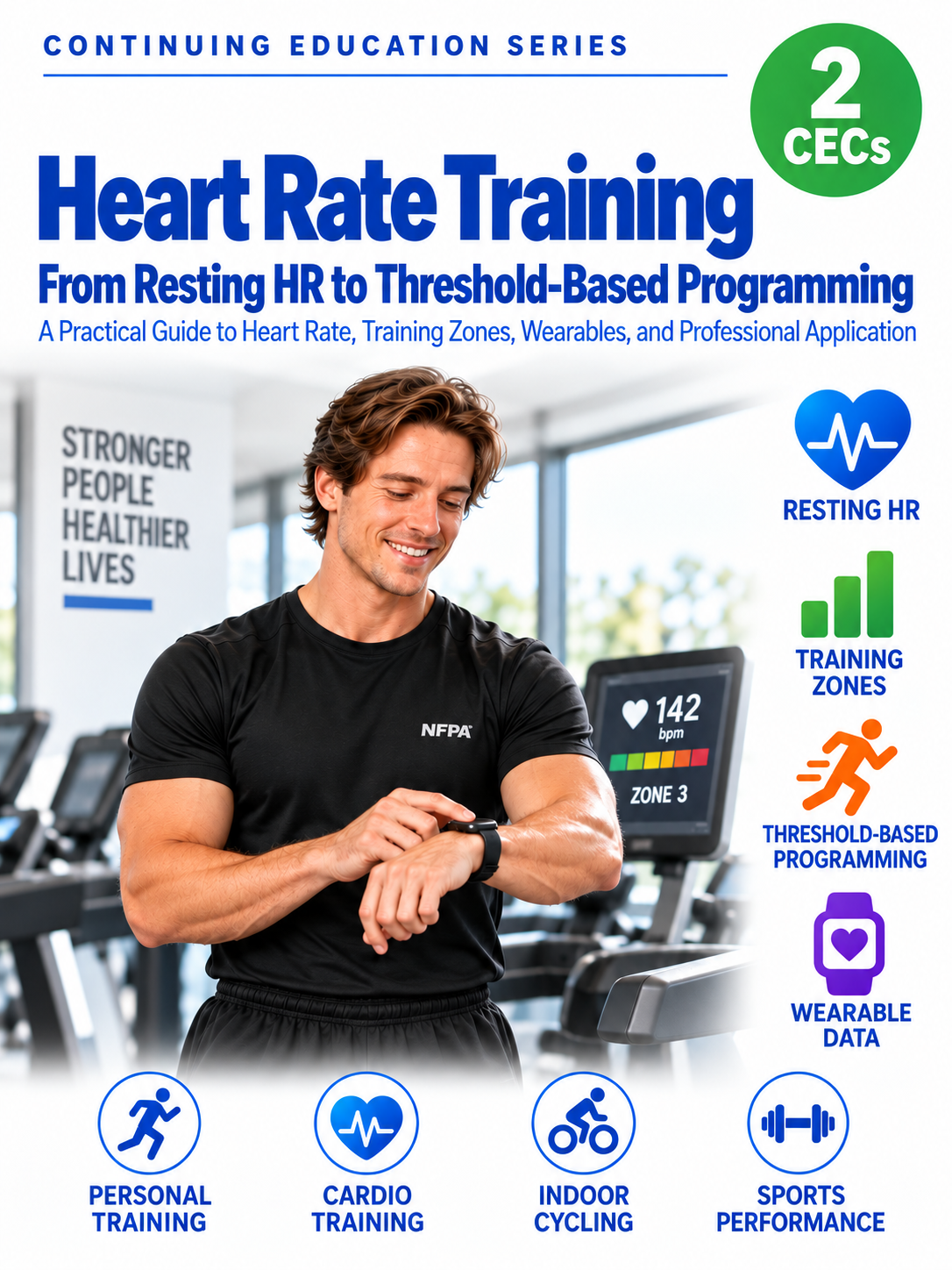
Heart Rate Training is a 2-CEC continuing education course designed to help fitness professionals understand resting heart rate, predicted maximal heart rate, heart-rate reserve, training zones, physiological thresholds, wearable technology, and professional interpretation of exercise intensity.
The course explains how heart rate can provide valuable information about cardiovascular response while also showing why the same heart rate may mean different things for different clients. Fitness level, age, medications, heat, hydration, stress, sleep, exercise mode, and individual physiology can all affect interpretation.
Topics include:
• Resting heart rate and baseline measurement
• Predicted maximal heart rate and its limitations
• Percentage-of-HRmax programming
• Heart-rate reserve and target-heart-rate calculations
• Why heart-rate zones are not universally standardized
• Five-zone versus threshold-based models
• Ventilatory and lactate thresholds
• RPE and the Talk Test
• Cardiac drift, heat, hydration, stress, and fatigue
• Medications and altered heart-rate response
• Wearable heart-rate monitors and device limitations
• Continuous aerobic and interval training
• Heart-rate recovery
• Professional scope and referral considerations
• The NFPA Heart Rate Coaching Process
Course Includes:
2 NFPA Continuing Education Credits
Self-paced PDF course
Practical calculations and programming examples
Wearable and heart-rate interpretation guidance
Practice Knowledge Check with answer key
Course Code: CEC-HRT-201
Heart rate is information—not a command.
From Resting HR to Threshold-Based Programming
Learn how to use heart rate as a practical coaching tool without treating a number, formula, zone, or wearable device as absolute.
Heart Rate Training is a 2-CEC continuing education course designed to help fitness professionals understand resting heart rate, predicted maximal heart rate, heart-rate reserve, training zones, physiological thresholds, wearable technology, and professional interpretation of exercise intensity.
The course explains how heart rate can provide valuable information about cardiovascular response while also showing why the same heart rate may mean different things for different clients. Fitness level, age, medications, heat, hydration, stress, sleep, exercise mode, and individual physiology can all affect interpretation.
Topics include:
• Resting heart rate and baseline measurement
• Predicted maximal heart rate and its limitations
• Percentage-of-HRmax programming
• Heart-rate reserve and target-heart-rate calculations
• Why heart-rate zones are not universally standardized
• Five-zone versus threshold-based models
• Ventilatory and lactate thresholds
• RPE and the Talk Test
• Cardiac drift, heat, hydration, stress, and fatigue
• Medications and altered heart-rate response
• Wearable heart-rate monitors and device limitations
• Continuous aerobic and interval training
• Heart-rate recovery
• Professional scope and referral considerations
• The NFPA Heart Rate Coaching Process
Course Includes:
2 NFPA Continuing Education Credits
Self-paced PDF course
Practical calculations and programming examples
Wearable and heart-rate interpretation guidance
Practice Knowledge Check with answer key
Course Code: CEC-HRT-201
Heart rate is information—not a command.