 Image 1 of 1
Exercise, Load Management, Movement, and Professional Decision-Making
A Practical Guide to Building Strength, Capacity, Confidence, and Function in Clients With Low Back Concerns *
Then paste this description underneath:
Help clients build strength, movement confidence, and physical capacity without oversimplifying low back pain or exceeding professional scope.
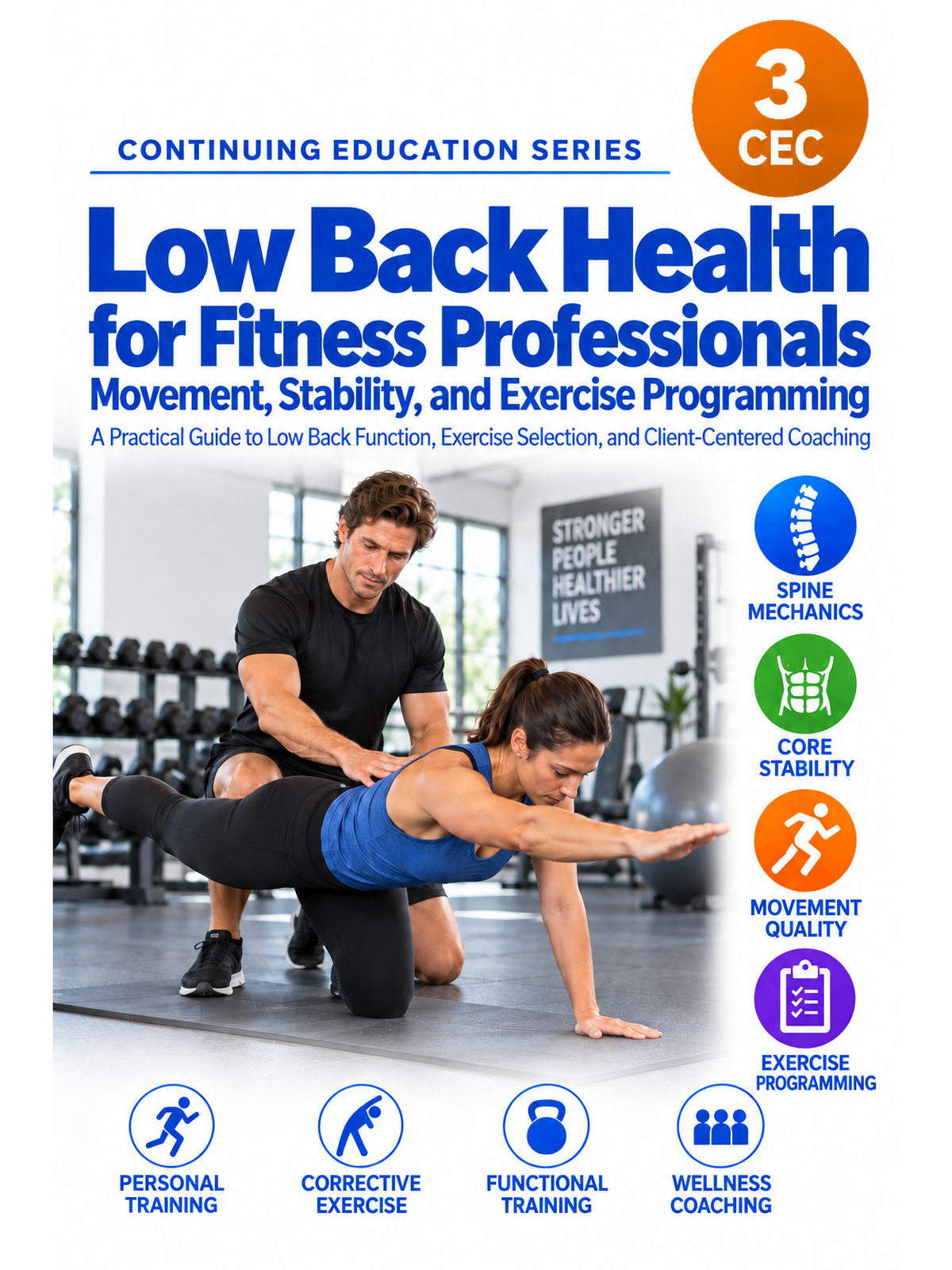
Low Back Health for Fitness Professionals is a comprehensive 3-CEC continuing education course designed to help fitness professionals work more effectively with clients who have current or previous low back concerns.
The course moves beyond fear-based explanations of the spine and simplistic ideas about posture, core weakness, or “bad” movement. Instead, it presents low back health through a practical evidence-informed framework that considers movement, physical capacity, training load, recovery, beliefs, symptoms, health history, and professional scope.
Fitness professionals are not responsible for diagnosing the source of a client’s pain. Their role is to screen appropriately, recognize red flags, understand the client’s goals and limitations, identify useful movement options, build strength and conditioning gradually, monitor the response to training, and refer when symptoms or circumstances exceed fitness scope.
Topics include:
Specific versus non-specific low back pain
Basic lumbar-spine anatomy and load sharing
Pain, imaging, beliefs, and the biopsychosocial model
Common age-related imaging findings
Red flags and neurological symptoms
Fitness-professional screening and referral
Posture, spinal flexion, and normal movement
Load, capacity, recovery, and adaptation
General resistance training for clients with low back concerns
Core training without “core” mythology
Bracing, trunk endurance, and controlled movement
Squat, hinge, carry, push, and pull progressions
Walking and aerobic conditioning
Graded exposure and movement confidence
Symptom flare-ups and exercise-dose modification
Load, range, volume, speed, and exercise-choice adjustments
Training older adults and resistance-trained clients
Work, sport, and real-life capacity
12-week low back capacity programming
Communication, collaboration, and professional boundaries
The NFPA Low Back Health Coaching Process
Course Includes:
3 NFPA Continuing Education Credits
Self-paced PDF course
Practical exercise progressions and programming examples
Red-flag and referral guidance
Symptom-monitoring strategies
Applied client cases
Practice Knowledge Check with answer key
Course Code: CEC-LB-301
Screen first. Keep people moving when movement is appropriate. Build capacity gradually. Train the person—not the MRI.
Exercise, Load Management, Movement, and Professional Decision-Making
A Practical Guide to Building Strength, Capacity, Confidence, and Function in Clients With Low Back Concerns *
Then paste this description underneath:
Help clients build strength, movement confidence, and physical capacity without oversimplifying low back pain or exceeding professional scope.
Low Back Health for Fitness Professionals is a comprehensive 3-CEC continuing education course designed to help fitness professionals work more effectively with clients who have current or previous low back concerns.
The course moves beyond fear-based explanations of the spine and simplistic ideas about posture, core weakness, or “bad” movement. Instead, it presents low back health through a practical evidence-informed framework that considers movement, physical capacity, training load, recovery, beliefs, symptoms, health history, and professional scope.
Fitness professionals are not responsible for diagnosing the source of a client’s pain. Their role is to screen appropriately, recognize red flags, understand the client’s goals and limitations, identify useful movement options, build strength and conditioning gradually, monitor the response to training, and refer when symptoms or circumstances exceed fitness scope.
Topics include:
Specific versus non-specific low back pain
Basic lumbar-spine anatomy and load sharing
Pain, imaging, beliefs, and the biopsychosocial model
Common age-related imaging findings
Red flags and neurological symptoms
Fitness-professional screening and referral
Posture, spinal flexion, and normal movement
Load, capacity, recovery, and adaptation
General resistance training for clients with low back concerns
Core training without “core” mythology
Bracing, trunk endurance, and controlled movement
Squat, hinge, carry, push, and pull progressions
Walking and aerobic conditioning
Graded exposure and movement confidence
Symptom flare-ups and exercise-dose modification
Load, range, volume, speed, and exercise-choice adjustments
Training older adults and resistance-trained clients
Work, sport, and real-life capacity
12-week low back capacity programming
Communication, collaboration, and professional boundaries
The NFPA Low Back Health Coaching Process
Course Includes:
3 NFPA Continuing Education Credits
Self-paced PDF course
Practical exercise progressions and programming examples
Red-flag and referral guidance
Symptom-monitoring strategies
Applied client cases
Practice Knowledge Check with answer key
Course Code: CEC-LB-301
Screen first. Keep people moving when movement is appropriate. Build capacity gradually. Train the person—not the MRI.