 Image 1 of 1
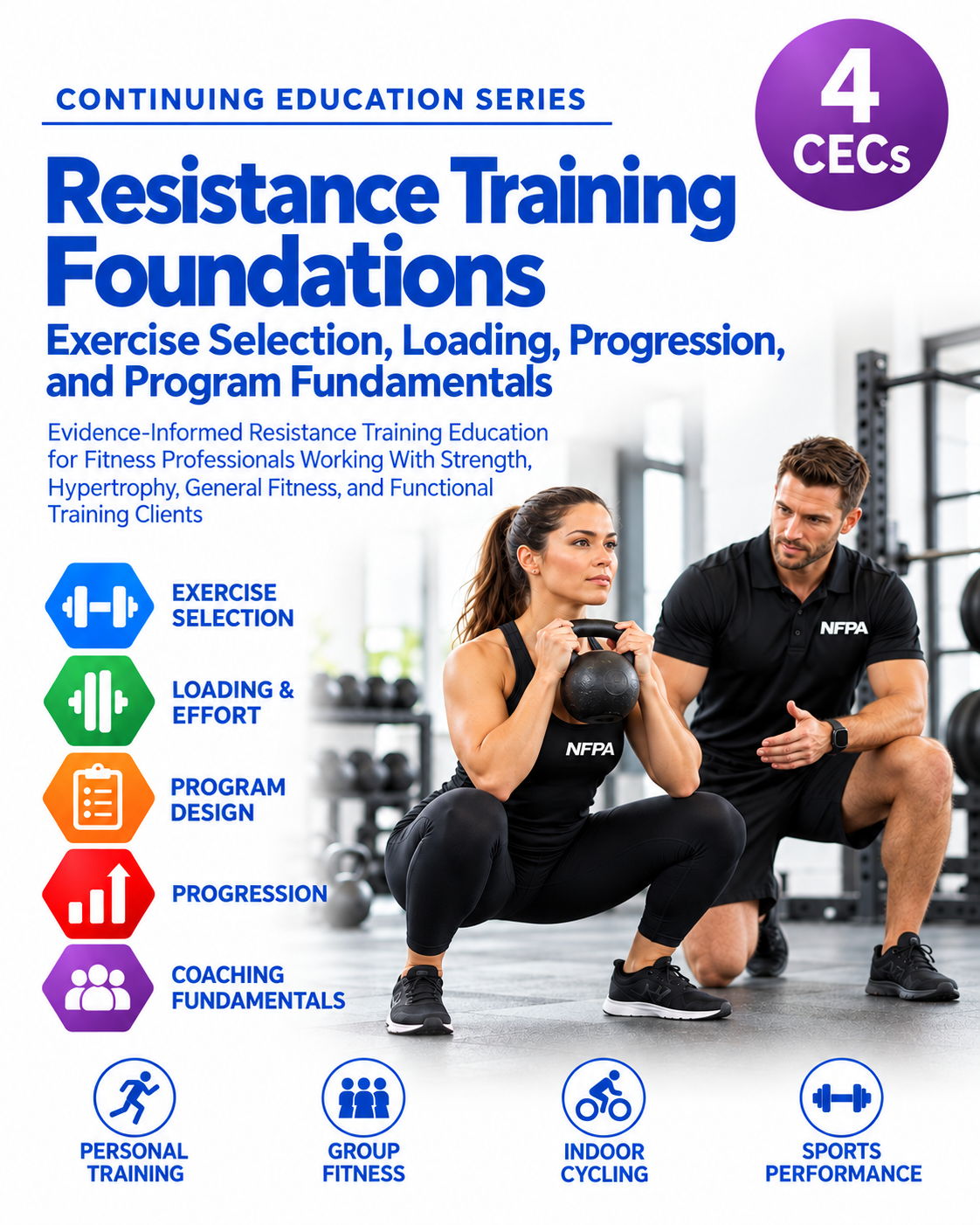
Resistance Training Foundations
Exercise Selection, Loading, Progression, and Program Fundamentals
Learn how to design effective resistance-training programs using evidence-informed principles of exercise selection, training intensity, loading, volume, recovery, and progressive overload.
Resistance Training Foundations is a practical 4-CEC continuing education course exploring the essential principles of resistance exercise for fitness professionals working with clients pursuing strength, muscular hypertrophy, endurance, power, physical function, and general fitness.
The course examines how resistance training produces neurological, muscular, and structural adaptations, and why effective programming begins with the client's goals rather than a predetermined exercise or training method.
Fitness professionals will learn how to select appropriate exercises, choose effective resistance levels, interpret repetitions in reserve (RIR), and organize sets, repetitions, rest periods, training frequency, and exercise order.
Special attention is given to distinguishing meaningful progressive overload from simply making workouts harder. The course explains why adding weight, volume, complexity, fatigue, or exercise variety is not automatically better.
Participants will learn how to compare free weights, machines, cables, bands, and bodyweight exercises while selecting equipment and movement patterns according to individual needs.
The course also addresses exercise technique, movement variability, warm-up strategies, recovery management, training plateaus, program adjustments, and professional scope of practice.
Fitness professionals will gain practical strategies for developing structured, progressive, repeatable, and individualized resistance-training programs.
Topics Include:
Understanding the NFPA Resistance Training Philosophy
Neurological adaptations to resistance training
Muscular hypertrophy and structural adaptations
Connective tissue, tendon, and bone-loading considerations
Strength, hypertrophy, muscular endurance, and power development
Establishing training goals before selecting exercises
General fitness versus sport-specific resistance training
Movement-pattern-based exercise selection
Squat, hinge, push, pull, unilateral, and trunk exercises
Multi-joint versus single-joint resistance exercises
Exercise substitutions that preserve the training objective
Machines, free weights, cables, resistance bands, and bodyweight training
Individual anatomy and movement-technique variation
Appropriate range of motion and exercise tolerance
Resistance loading and percentage-based programming
One-repetition maximum and repetition maximum concepts
Understanding repetition ranges and their limitations
Rating of Perceived Exertion (RPE)
Repetitions in Reserve (RIR)
Training proximity to muscular failure
Technical failure and movement standards
Sets, repetitions, and productive training volume
Weekly training frequency and training distribution
Rest intervals for strength, hypertrophy, and endurance
Exercise order and training priorities
Effective warm-up and exercise preparation
Eccentric, concentric, and isometric muscle actions
Exercise tempo and movement speed
Progressive overload through load, repetitions, volume, and range
Double progression and structured loading strategies
Exercise regression and progression
Training consistency and exercise variation
Monitoring performance, fatigue, and recovery
Recognizing when more training is not the solution
Constructing two-day, three-day, and split resistance-training programs
Individualized training for beginners and experienced clients
Practical resistance-training coaching case studies
Professional scope of practice and referral
The NFPA Resistance Training Process
Course Includes:
4 NFPA Continuing Education Credits
Self-paced PDF continuing education course
20-question Practice Knowledge Check with answer key and explanations
3 applied coaching case studies addressing beginner training, exercise variation, and managing training plateaus
Practical resistance-training program examples and exercise-selection frameworks
Evidence-informed guidance for loading, progressive overload, recovery, and individualized program design
Course Code: CEC-RTF-401
Choose the goal. Select the exercise. Apply the right dose. Monitor the response. Progress when earned.
Exercise Selection, Loading, Progression, and Program Fundamentals
Learn how to design effective resistance-training programs using evidence-informed principles of exercise selection, training intensity, loading, volume, recovery, and progressive overload.
Resistance Training Foundations is a practical 4-CEC continuing education course exploring the essential principles of resistance exercise for fitness professionals working with clients pursuing strength, muscular hypertrophy, endurance, power, physical function, and general fitness.
The course examines how resistance training produces neurological, muscular, and structural adaptations, and why effective programming begins with the client's goals rather than a predetermined exercise or training method.
Fitness professionals will learn how to select appropriate exercises, choose effective resistance levels, interpret repetitions in reserve (RIR), and organize sets, repetitions, rest periods, training frequency, and exercise order.
Special attention is given to distinguishing meaningful progressive overload from simply making workouts harder. The course explains why adding weight, volume, complexity, fatigue, or exercise variety is not automatically better.
Participants will learn how to compare free weights, machines, cables, bands, and bodyweight exercises while selecting equipment and movement patterns according to individual needs.
The course also addresses exercise technique, movement variability, warm-up strategies, recovery management, training plateaus, program adjustments, and professional scope of practice.
Fitness professionals will gain practical strategies for developing structured, progressive, repeatable, and individualized resistance-training programs.
Topics Include:
Understanding the NFPA Resistance Training Philosophy
Neurological adaptations to resistance training
Muscular hypertrophy and structural adaptations
Connective tissue, tendon, and bone-loading considerations
Strength, hypertrophy, muscular endurance, and power development
Establishing training goals before selecting exercises
General fitness versus sport-specific resistance training
Movement-pattern-based exercise selection
Squat, hinge, push, pull, unilateral, and trunk exercises
Multi-joint versus single-joint resistance exercises
Exercise substitutions that preserve the training objective
Machines, free weights, cables, resistance bands, and bodyweight training
Individual anatomy and movement-technique variation
Appropriate range of motion and exercise tolerance
Resistance loading and percentage-based programming
One-repetition maximum and repetition maximum concepts
Understanding repetition ranges and their limitations
Rating of Perceived Exertion (RPE)
Repetitions in Reserve (RIR)
Training proximity to muscular failure
Technical failure and movement standards
Sets, repetitions, and productive training volume
Weekly training frequency and training distribution
Rest intervals for strength, hypertrophy, and endurance
Exercise order and training priorities
Effective warm-up and exercise preparation
Eccentric, concentric, and isometric muscle actions
Exercise tempo and movement speed
Progressive overload through load, repetitions, volume, and range
Double progression and structured loading strategies
Exercise regression and progression
Training consistency and exercise variation
Monitoring performance, fatigue, and recovery
Recognizing when more training is not the solution
Constructing two-day, three-day, and split resistance-training programs
Individualized training for beginners and experienced clients
Practical resistance-training coaching case studies
Professional scope of practice and referral
The NFPA Resistance Training Process
Course Includes:
4 NFPA Continuing Education Credits
Self-paced PDF continuing education course
20-question Practice Knowledge Check with answer key and explanations
3 applied coaching case studies addressing beginner training, exercise variation, and managing training plateaus
Practical resistance-training program examples and exercise-selection frameworks
Evidence-informed guidance for loading, progressive overload, recovery, and individualized program design
Course Code: CEC-RTF-401
Choose the goal. Select the exercise. Apply the right dose. Monitor the response. Progress when earned.