 Image 1 of 1
Suspension Training: Exercise and Progression
Exercise Technique, Progressions, and Program Design
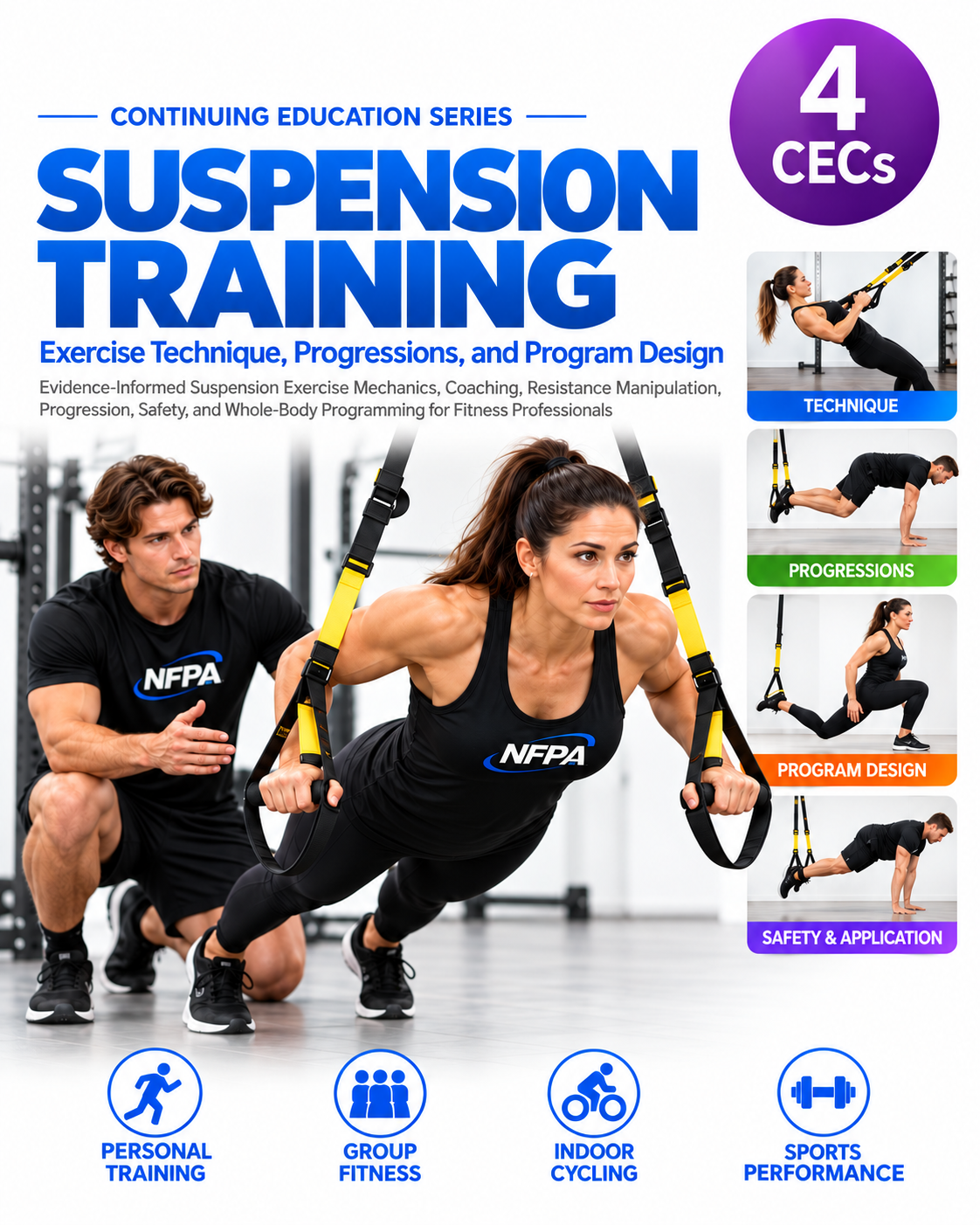
Learn how to use suspension training systems to develop strength, muscular endurance, movement control, balance, trunk stability, and whole-body conditioning through effective exercise technique and progressive programming.
Suspension Training is a practical 4-CEC continuing education course exploring evidence-informed suspension exercise mechanics, resistance manipulation, professional coaching, exercise progression, and individualized program design.
The course examines how suspension training uses body weight, gravity, leverage, body angle, and adjustable support to create resistance. Fitness professionals will learn why changing a client's body position can substantially alter exercise difficulty without adding conventional external weights.
Special attention is given to understanding instability and its appropriate role in exercise programming. Participants will learn why greater instability does not automatically produce greater strength, muscular development, or functional improvement.
Fitness professionals will explore proper suspension equipment setup, anchor-point safety, controlled movement technique, and safe entry and exit procedures.
The course provides practical instruction for suspension squats, lunges, rows, presses, hamstring curls, planks, trunk exercises, and integrated full-body movements.
Participants will learn how to adjust body angle, base of support, lever length, range of motion, tempo, strap positioning, and training volume to develop progressive exercise programs.
The course also addresses suspension training for beginners, older adults, general fitness clients, athletes, and group exercise environments while maintaining appropriate professional boundaries.
Topics Include:
Understanding suspension training as resistance exercise
Gravity, body weight, leverage, and mechanical loading
How body angle changes resistance
Center of mass and base of support
Strap length, positioning, and exercise difficulty
Understanding instability and muscular activation
Suspension training versus traditional resistance exercise
Equipment inspection and secure anchor points
Strap tension, handle control, and safe body positioning
Safe exercise entry and exit procedures
Foundational movement technique and coaching cues
Suspension-supported squats and squat progressions
Split squats, lunges, and unilateral lower-body training
Assisted single-leg squat progressions
Rear-foot-suspended split squats
Hip-hinge exercises and posterior-chain development
Suspended bridges and hamstring curls
Upper-body pulling and suspension row progressions
Single-arm rows and rotational variations
Reverse flies, Y raises, and biceps exercises
Standing suspension chest presses
Suspended push-up progressions
Single-arm pressing and triceps exercises
Trunk control and anti-extension training
Suspended planks, knee tucks, and mountain climbers
Body saw, pike, and advanced trunk exercises
Anti-rotation and controlled rotational movements
Progressive overload using body angle and leverage
Training intensity, RPE, and repetitions in reserve
Programming for strength and muscular hypertrophy
Muscular endurance and conditioning circuits
Balance, coordination, and power development
Suspension training for beginners and older adults
Exercise modifications for selected special populations
Integrating suspension training with free weights and machines
Suspension training for athletes and sports performance
Organizing suspension training in group settings
Equipment safety, exercise monitoring, and professional referral
Practical suspension-training coaching scenarios
The NFPA Suspension Training Programming Process
Course Includes:
4 NFPA Continuing Education Credits
Self-paced PDF continuing education course
20-question Practice Knowledge Check with answer key and explanations
15 applied coaching cases involving exercise technique, progression, training difficulty, client safety, and practical programming
Suspension exercise progressions for upper-body, lower-body, and trunk training
Practical full-body, conditioning, and integrated resistance-training program examples
Evidence-informed guidance for safe equipment use and resistance manipulation
Control the position. Control the resistance. Build the movement. Progress the load.
Exercise Technique, Progressions, and Program Design
Learn how to use suspension training systems to develop strength, muscular endurance, movement control, balance, trunk stability, and whole-body conditioning through effective exercise technique and progressive programming.
Suspension Training is a practical 4-CEC continuing education course exploring evidence-informed suspension exercise mechanics, resistance manipulation, professional coaching, exercise progression, and individualized program design.
The course examines how suspension training uses body weight, gravity, leverage, body angle, and adjustable support to create resistance. Fitness professionals will learn why changing a client's body position can substantially alter exercise difficulty without adding conventional external weights.
Special attention is given to understanding instability and its appropriate role in exercise programming. Participants will learn why greater instability does not automatically produce greater strength, muscular development, or functional improvement.
Fitness professionals will explore proper suspension equipment setup, anchor-point safety, controlled movement technique, and safe entry and exit procedures.
The course provides practical instruction for suspension squats, lunges, rows, presses, hamstring curls, planks, trunk exercises, and integrated full-body movements.
Participants will learn how to adjust body angle, base of support, lever length, range of motion, tempo, strap positioning, and training volume to develop progressive exercise programs.
The course also addresses suspension training for beginners, older adults, general fitness clients, athletes, and group exercise environments while maintaining appropriate professional boundaries.
Topics Include:
Understanding suspension training as resistance exercise
Gravity, body weight, leverage, and mechanical loading
How body angle changes resistance
Center of mass and base of support
Strap length, positioning, and exercise difficulty
Understanding instability and muscular activation
Suspension training versus traditional resistance exercise
Equipment inspection and secure anchor points
Strap tension, handle control, and safe body positioning
Safe exercise entry and exit procedures
Foundational movement technique and coaching cues
Suspension-supported squats and squat progressions
Split squats, lunges, and unilateral lower-body training
Assisted single-leg squat progressions
Rear-foot-suspended split squats
Hip-hinge exercises and posterior-chain development
Suspended bridges and hamstring curls
Upper-body pulling and suspension row progressions
Single-arm rows and rotational variations
Reverse flies, Y raises, and biceps exercises
Standing suspension chest presses
Suspended push-up progressions
Single-arm pressing and triceps exercises
Trunk control and anti-extension training
Suspended planks, knee tucks, and mountain climbers
Body saw, pike, and advanced trunk exercises
Anti-rotation and controlled rotational movements
Progressive overload using body angle and leverage
Training intensity, RPE, and repetitions in reserve
Programming for strength and muscular hypertrophy
Muscular endurance and conditioning circuits
Balance, coordination, and power development
Suspension training for beginners and older adults
Exercise modifications for selected special populations
Integrating suspension training with free weights and machines
Suspension training for athletes and sports performance
Organizing suspension training in group settings
Equipment safety, exercise monitoring, and professional referral
Practical suspension-training coaching scenarios
The NFPA Suspension Training Programming Process
Course Includes:
4 NFPA Continuing Education Credits
Self-paced PDF continuing education course
20-question Practice Knowledge Check with answer key and explanations
15 applied coaching cases involving exercise technique, progression, training difficulty, client safety, and practical programming
Suspension exercise progressions for upper-body, lower-body, and trunk training
Practical full-body, conditioning, and integrated resistance-training program examples
Evidence-informed guidance for safe equipment use and resistance manipulation
Control the position. Control the resistance. Build the movement. Progress the load.