2 CEC
Continuing Education Courses

Focused Education. Practical Application. Professional Growth.
Expand your professional knowledge with focused NFPA continuing education courses designed for practical application. Each course below provides 2 NFPA Continuing Education Credits and is delivered as a self-paced digital course you can study on your schedule.




Select the topic that best matches your professional interests, client needs, or continuing education goals.
Choose Your 2 CEC Course
From Resting HR to Threshold-Based Programming
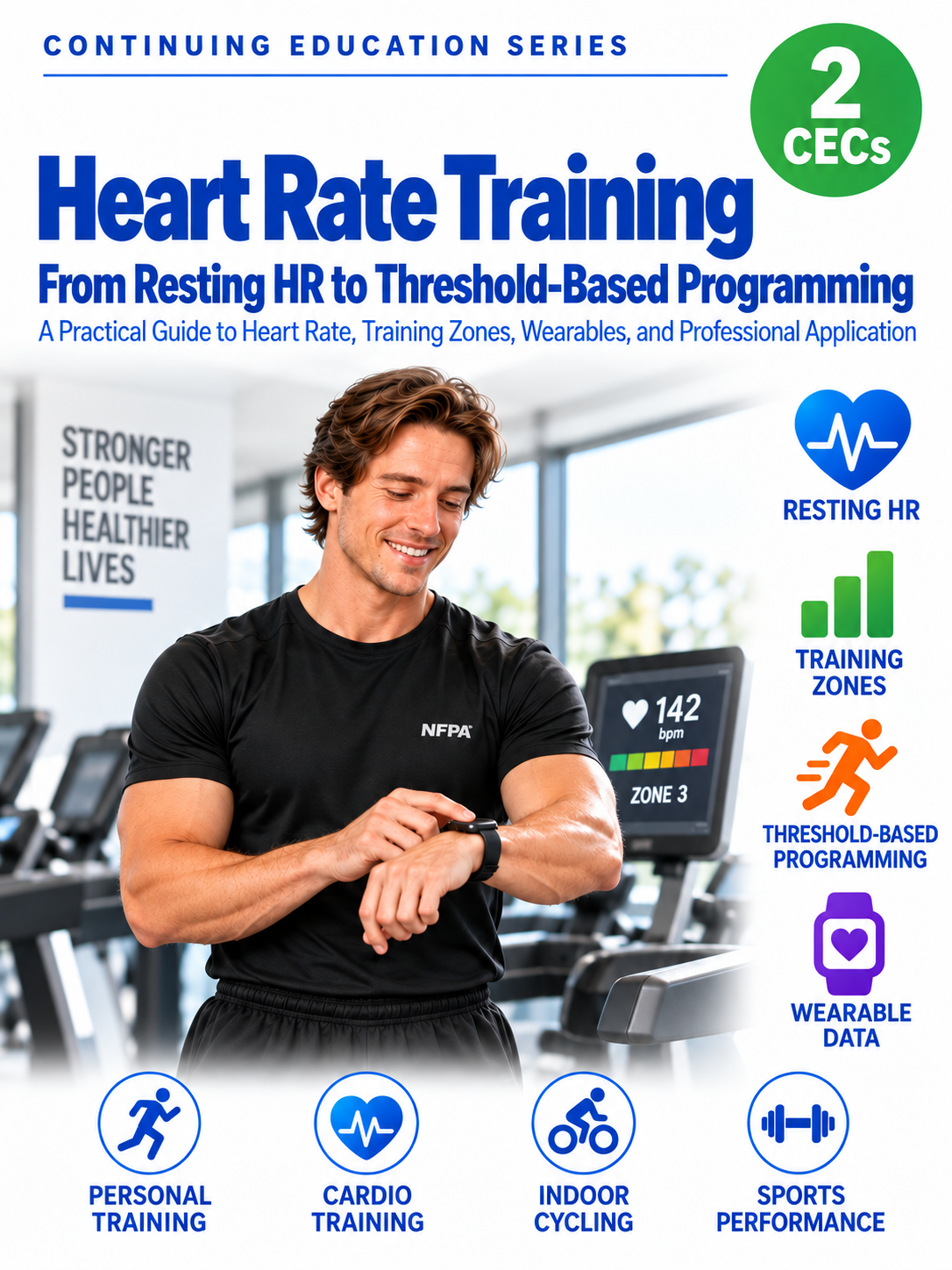
Learn how to use heart rate as a practical coaching tool without treating a number, formula, zone, or wearable device as absolute.
Heart Rate Training is a 2-CEC continuing education course designed to help fitness professionals understand resting heart rate, predicted maximal heart rate, heart-rate reserve, training zones, physiological thresholds, wearable technology, and professional interpretation of exercise intensity.
The course explains how heart rate can provide valuable information about cardiovascular response while also showing why the same heart rate may mean different things for different clients. Fitness level, age, medications, heat, hydration, stress, sleep, exercise mode, and individual physiology can all affect interpretation.
Topics include:
• Resting heart rate and baseline measurement
• Predicted maximal heart rate and its limitations
• Percentage-of-HRmax programming
• Heart-rate reserve and target-heart-rate calculations
• Why heart-rate zones are not universally standardized
• Five-zone versus threshold-based models
• Ventilatory and lactate thresholds
• RPE and the Talk Test
• Cardiac drift, heat, hydration, stress, and fatigue
• Medications and altered heart-rate response
• Wearable heart-rate monitors and device limitations
• Continuous aerobic and interval training
• Heart-rate recovery
• Professional scope and referral considerations
• The NFPA Heart Rate Coaching Process
Course Includes:
2 NFPA Continuing Education Credits
Self-paced PDF course
Practical calculations and programming examples
Wearable and heart-rate interpretation guidance
Practice Knowledge Check with answer key
Course Code: CEC-HRT-201
Heart rate is information—not a command.
Principles, Safety, and Programming
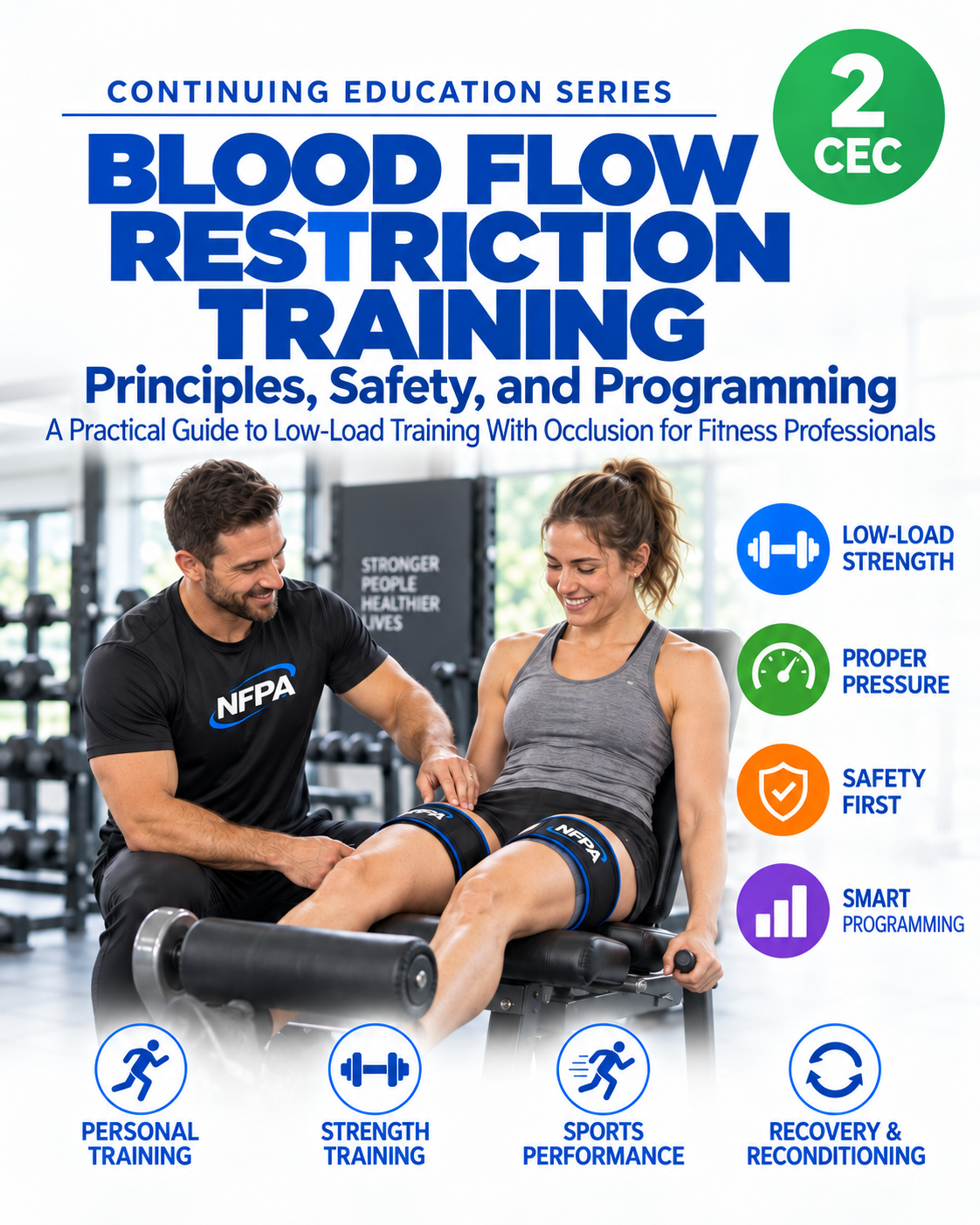
Learn how blood flow restriction training can be used as a specialized low-load training method while maintaining appropriate screening, pressure selection, programming, monitoring, and professional scope.
Blood Flow Restriction Training is a 2-CEC continuing education course designed to give fitness professionals an evidence-informed understanding of BFR physiology, equipment, individualized cuff pressure, exercise selection, programming, safety, and professional application.
The course explains why BFR can allow relatively light external loads to create a substantial muscular training stimulus while also emphasizing that BFR is not simply a matter of tightening a band around a limb and exercising. Responsible application requires appropriate equipment, individualized pressure, client screening, conservative programming, symptom monitoring, and professional judgment.
Topics include:
• What blood flow restriction training is and how it works
• Partial arterial restriction versus complete occlusion
• BFR physiology and muscular adaptation
• Low-load BFR versus traditional resistance training
• Arterial and limb occlusion pressure
• Cuff width, design, placement, and pressure selection
• Evidence-informed loads, repetitions, sets, and rest intervals
• Cardiovascular and thrombotic considerations
• Client screening, medical clearance, and referral
• BFR for hypertrophy, strength, older adults, and athletes
• Common BFR mistakes and unsafe practices
• Conservative first-session programming
• Progression and documentation
• The NFPA BFR Decision System
Course Includes:
2 NFPA Continuing Education Credits
Self-paced PDF course
Practical programming examples
Safety and professional-scope guidance
Practice Knowledge Check with answer key
Course Code: CEC-BFR-201
BFR is a specialized training tool—not a universal replacement for conventional resistance training.
Evidence, Dosing, Safety, and Professional Scope
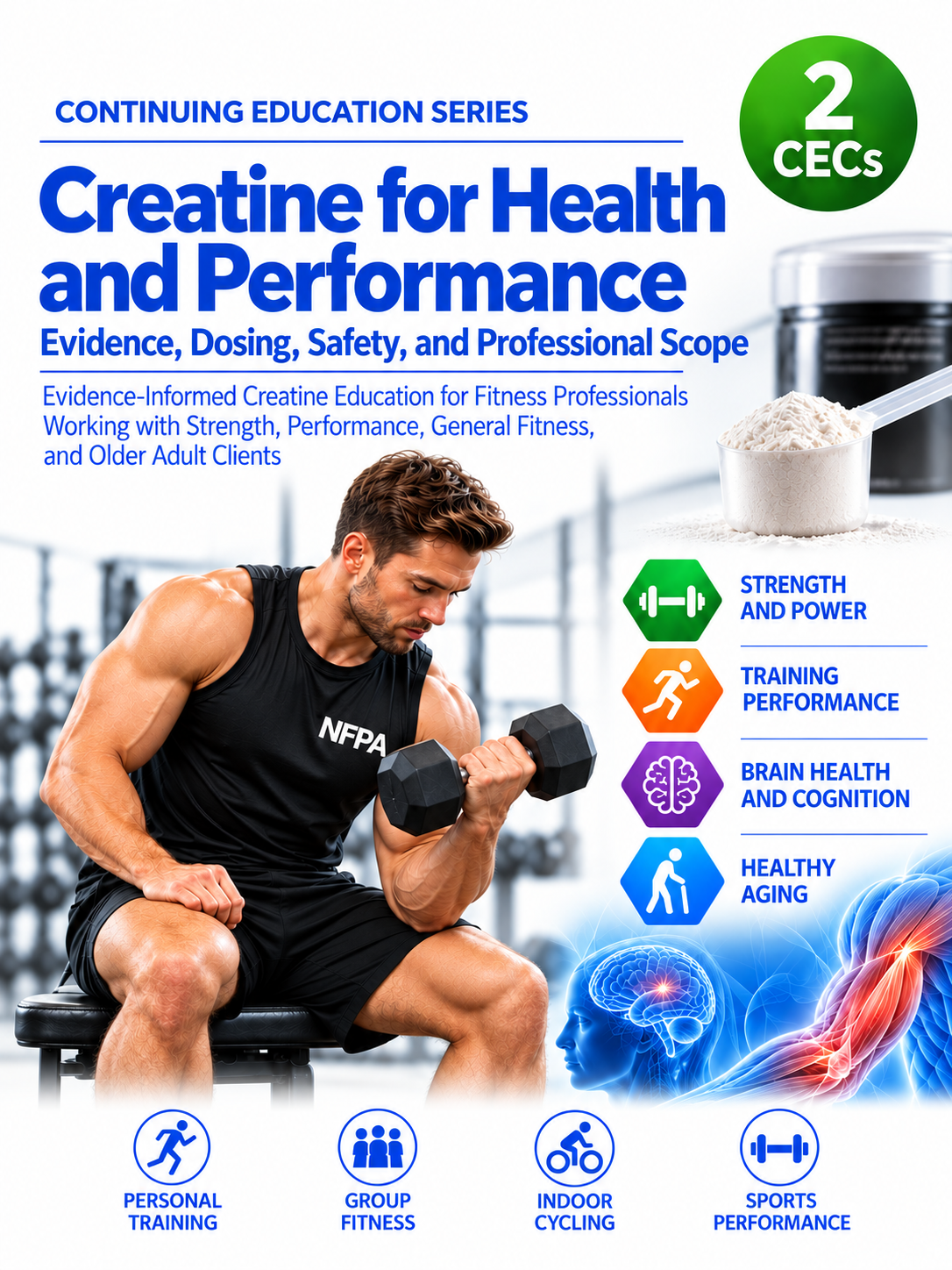
Learn how to explain creatine supplementation accurately, distinguish established performance benefits from emerging health claims, and provide evidence-informed education while respecting professional scope of practice.
Creatine for Health and Performance is a practical 2-CEC continuing education course exploring one of the most extensively studied dietary supplements in exercise science.
The course examines how creatine supports rapid ATP regeneration, why supplementation can improve resistance training and repeated high-intensity performance, and how common dosing strategies influence muscle creatine saturation.
Fitness professionals will learn how to explain early body-weight changes, evaluate common safety concerns, understand potential applications for older adults, and distinguish promising cognitive research from established evidence.
Special emphasis is placed on creatine monohydrate, realistic client expectations, supplement quality, medical considerations, and appropriate referral.
Topics Include:
Creatine physiology and the phosphocreatine energy system
ATP regeneration and repeated high-intensity exercise
Creatine supplementation for strength and resistance training
Power, sprint performance, and training capacity
Lean body mass and long-term training adaptations
Creatine monohydrate versus alternative supplement forms
Loading and non-loading dosing strategies
Common maintenance dosing and supplement timing
Creatine cycling and carbohydrate co-ingestion
Intracellular water, body-weight changes, and fat-gain misconceptions
Creatine for older adults and healthy aging
Emerging research on cognition and brain energy metabolism
Kidney function, serum creatinine, and laboratory interpretation
Hydration, muscle cramping, and gastrointestinal considerations
Common myths involving steroids, hair loss, and excessive dosing
Supplement quality and third-party certification
Considerations for kidney disease, pregnancy, adolescents, and complex medical conditions
Professional scope and appropriate healthcare referral
Practical client coaching scenarios
The NFPA Creatine Education Process
Course Includes:
2 NFPA Continuing Education Credits
Self-paced PDF continuing education course
10-question Practice Knowledge Check with answer key and explanations
Seven practical coaching cases covering performance, dosing, safety, and professional application
Course Code: CEC-CRT-201
Creatine is a well-studied performance tool—not a universal cure.
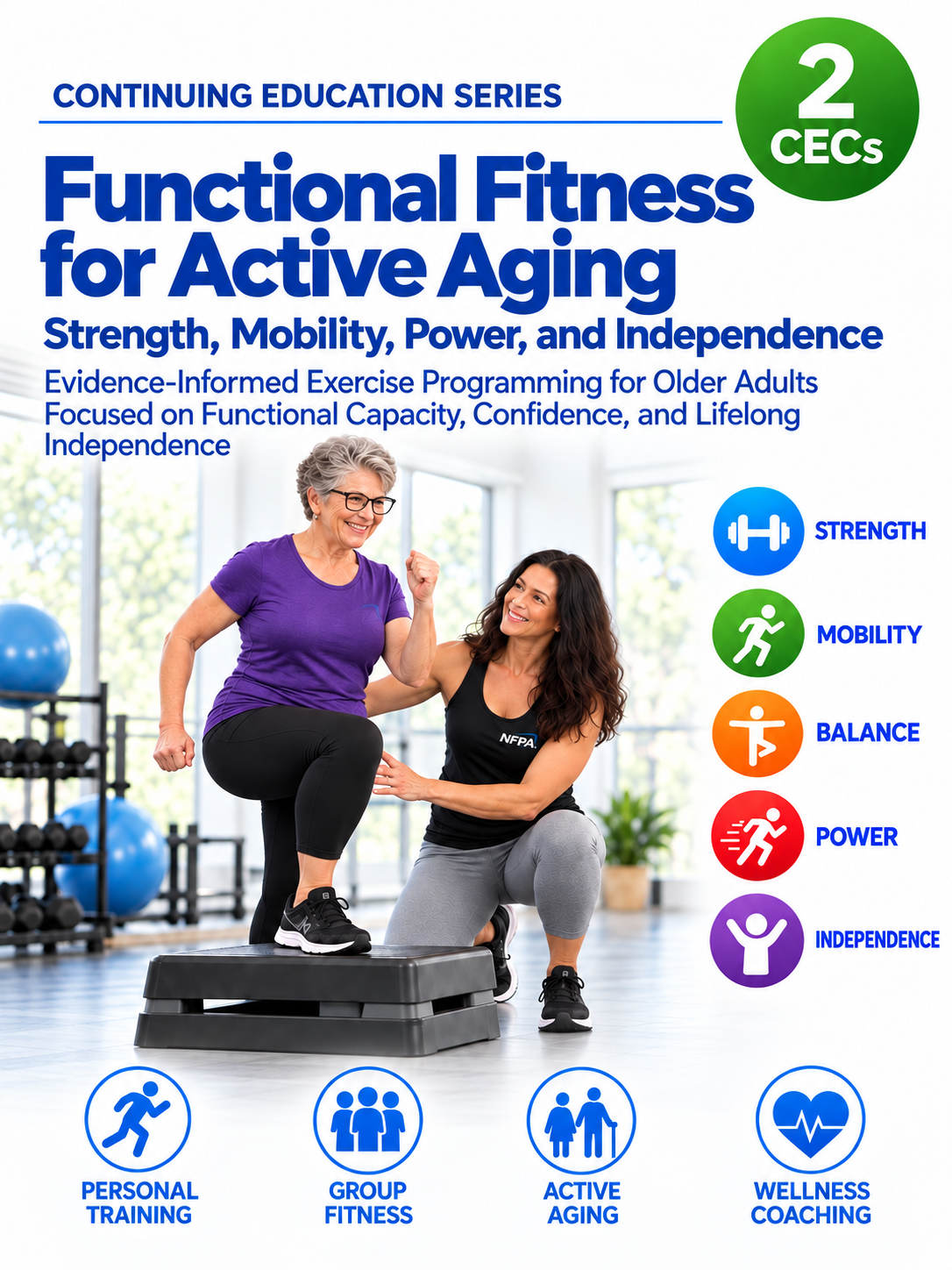
Strength, Mobility, Power, and Independence
Learn how to design safe, progressive exercise programs that help older adults improve strength, mobility, balance, muscular power, and the physical capacity needed for everyday independence.
Functional Fitness for Active Aging is a practical 2-CEC continuing education course exploring evidence-informed exercise programming for older adults, with an emphasis on functional capacity, confidence, and lifelong independence.
The course examines how age-related changes influence physical performance, why chronological age alone should not determine exercise selection, and how progressive resistance training can improve the physical reserve needed for everyday activities.
Fitness professionals will learn how to integrate strength, power, balance, mobility, and aerobic training into individualized programs for older adults of different abilities—from beginning exercisers to experienced, active seniors.
Special emphasis is placed on safe exercise progressions, functional assessment, fall-related confidence, medical considerations, and professional scope of practice.
Topics Include:
Understanding functional fitness and active aging
Chronological age versus functional capacity
Building functional reserve for everyday independence
Progressive resistance training for older adults
Strength, sarcopenia, and physical performance
Muscular power and age-related changes
Safe introductory power-training exercises
Static, dynamic, and reactive balance training
Fall-related confidence and movement progression
Mobility, flexibility, and functional movement
Walking, aerobic fitness, and activity tolerance
Sit-to-stand, gait speed, and functional assessments
Combining strength, power, balance, mobility, and aerobic exercise
Designing a multicomponent active-aging training week
Progressing sit-to-stand, step-ups, carries, and floor transfers
Exercise considerations for frail and pre-frail clients
Osteoporosis, arthritis, joint replacement, and chronic health conditions
Safety, symptoms, professional boundaries, and appropriate referral
Practical active-aging coaching scenarios
The NFPA Active Aging Programming Process
Course Includes:
2 NFPA Continuing Education Credits
Self-paced PDF continuing education course
10-question Practice Knowledge Check with answer key and explanations
Practical exercise progressions, programming examples, and applied coaching scenarios
Course Code: CEC-FAA-201
Train for the life the client wants to keep living.
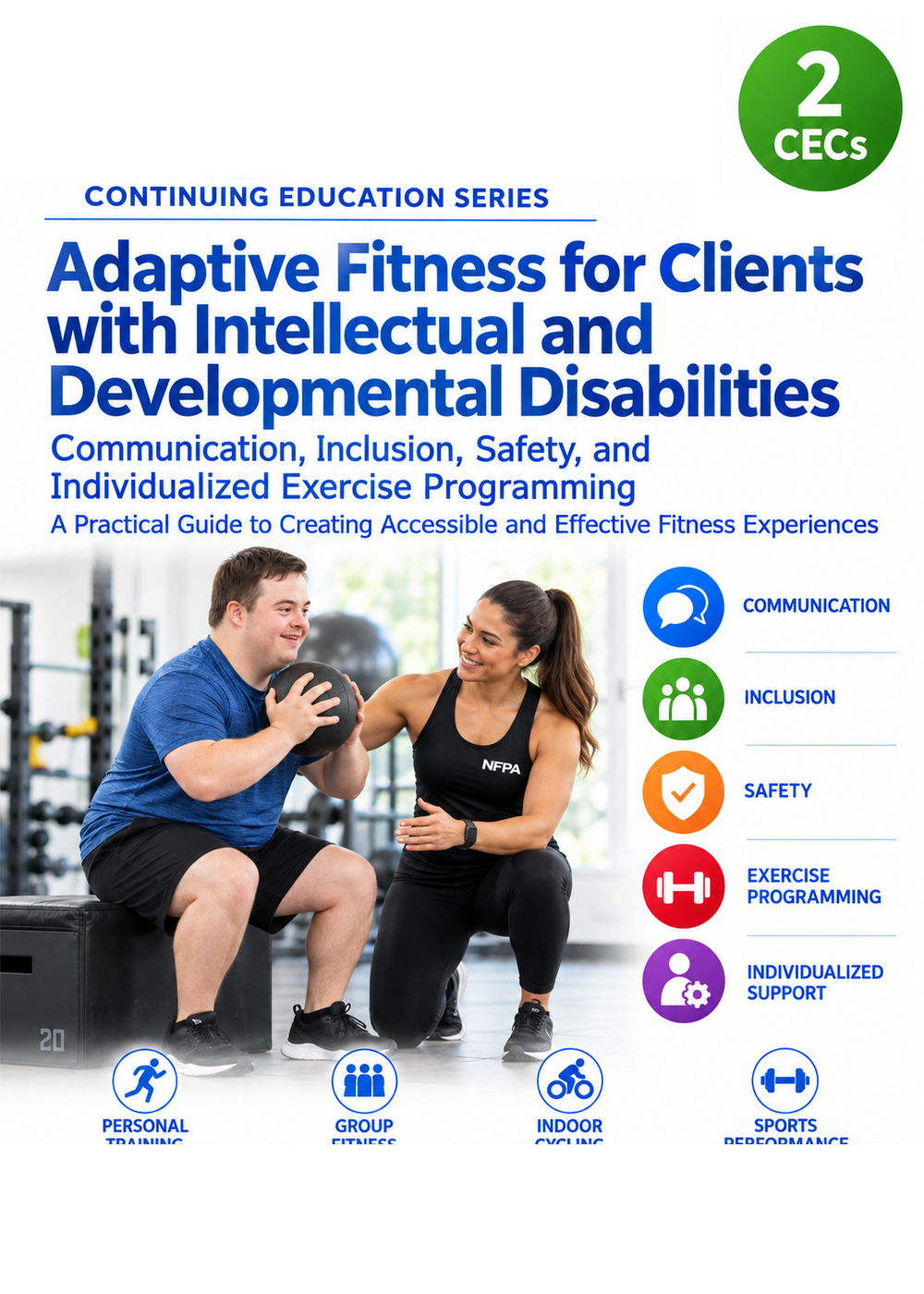
Communication, Inclusion, Safety, and Individualized Exercise Programming
Learn how to design inclusive, safe, and effective fitness experiences for clients with intellectual and developmental disabilities (IDD) while respecting individual abilities, preferences, communication styles, and personal goals.
Adaptive Fitness for Clients with Intellectual and Developmental Disabilities is a practical 2-CEC continuing education course exploring person-centered coaching, accessible instruction, individualized exercise programming, and professional safety considerations.
The course examines how intellectual and developmental disabilities can influence communication, learning, sensory processing, motor coordination, and participation without automatically determining an individual's exercise capabilities.
Fitness professionals will learn how to remove unnecessary barriers, use effective teaching strategies, adapt exercise environments, and provide appropriately challenging resistance, cardiovascular, balance, and mobility training.
Special emphasis is placed on client autonomy, dignity, meaningful choice, collaboration with support persons, progressive exercise programming, and recognizing situations requiring healthcare referral.
Topics Include:
Understanding intellectual and developmental disabilities
Person-centered, ability-focused fitness coaching
Recognizing individual strengths, goals, and support needs
Avoiding assumptions and unnecessarily restrictive exercise programming
Clear communication, demonstrations, and simplified instructions
Visual schedules, exercise cards, repetition, and demonstration-back
Sensory sensitivities and environmental modifications
Understanding behavior as potential communication
Maintaining adult dignity, autonomy, and meaningful choice
Working appropriately with caregivers and support professionals
Fitness screening, health history, medications, and safety considerations
Seizure disorders and exercise precautions
Down syndrome, neurological warning signs, and referral
Autism-specific communication and sensory considerations
Resistance training and progressive overload
Cardiovascular training and exercise intensity monitoring
Balance, coordination, mobility, and motor-skill development
Inclusive group fitness programming
Measuring progress through strength, skill, confidence, and independence
Practical adaptive fitness coaching scenarios
The NFPA Adaptive Coaching Process
Course Includes:
2 NFPA Continuing Education Credits
Self-paced PDF continuing education course
10-question Practice Knowledge Check with answer key and explanations
Practical exercise adaptations, communication strategies, and applied coaching examples
Course Code: CEC-AFI-201
Adapt the support—not the expectation.
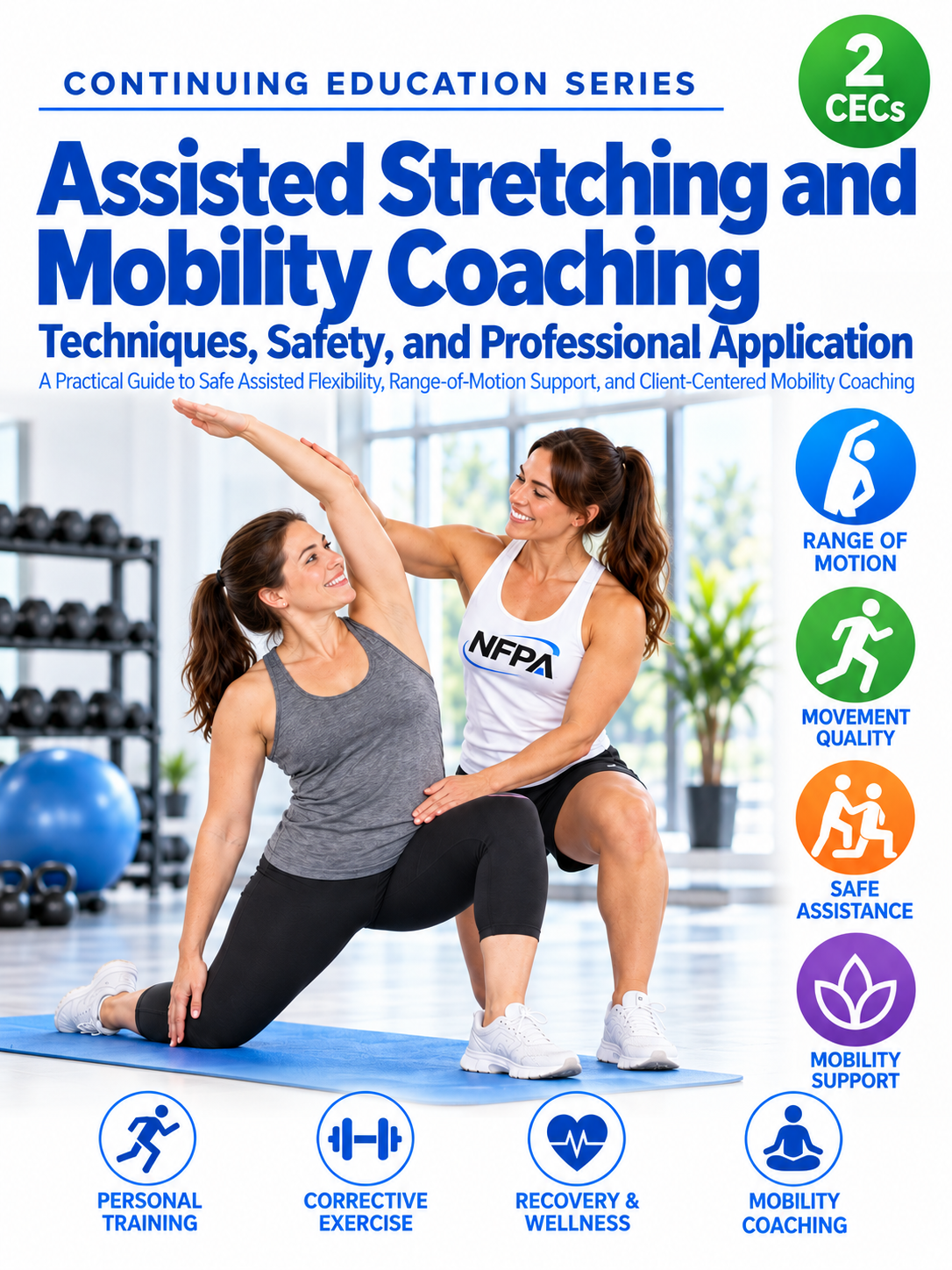
Techniques, Safety, and Professional Application
Learn how to help clients improve flexibility, usable range of motion, and movement quality through safe stretching techniques, appropriate hands-on assistance, and individualized mobility programming.
Assisted Stretching and Mobility Coaching is a practical 2-CEC continuing education course exploring evidence-informed flexibility training, assisted stretching, movement preparation, and professional coaching applications.
The course examines the differences between passive flexibility and functional mobility, how stretching influences range of motion, and when assisted stretching provides meaningful benefits beyond self-stretching, active mobility, or resistance training.
Fitness professionals will learn how to use appropriate positioning, controlled force, client communication, and ongoing consent when providing hands-on stretching assistance.
Special emphasis is placed on professional scope of practice, recognizing symptoms that require modification or referral, and helping clients develop the strength and control needed to use newly gained range of motion.
Topics Include:
Understanding flexibility, mobility, and usable range of motion
Passive versus active range of motion
Stretch tolerance and flexibility adaptations
Static, dynamic, ballistic, and PNF stretching methods
Self-stretching versus assisted stretching
Full-range resistance training and mobility development
Safe hand placement, stabilization, and force application
Trainer body mechanics during assisted stretching
Client consent and professional communication
Stretching intensity and client feedback
Recognizing pain, neurological symptoms, and warning signs
Static stretching dosage and progression
PNF hold-relax and contract-relax techniques
Stretching before and after exercise
Stretching, injury prevention, and recovery misconceptions
Assisted stretching for hamstrings, hips, quadriceps, and calves
Shoulder, chest, and neck stretching precautions
Mobility considerations for older adults
Osteoporosis, joint replacement, pregnancy, and hypermobility
Integrating passive range with active mobility and strength
Professional scope, documentation, and referral
Practical assisted stretching coaching scenarios
The NFPA Assisted Stretching Coaching Process
Course Includes:
2 NFPA Continuing Education Credits
Self-paced PDF continuing education course
10-question Practice Knowledge Check with answer key and explanations
Practical assisted-stretching techniques, mobility programming examples, and applied coaching scenarios
Course Code: CEC-ASM-201
Improve usable movement without forcing range, creating pain, or exceeding professional scope.
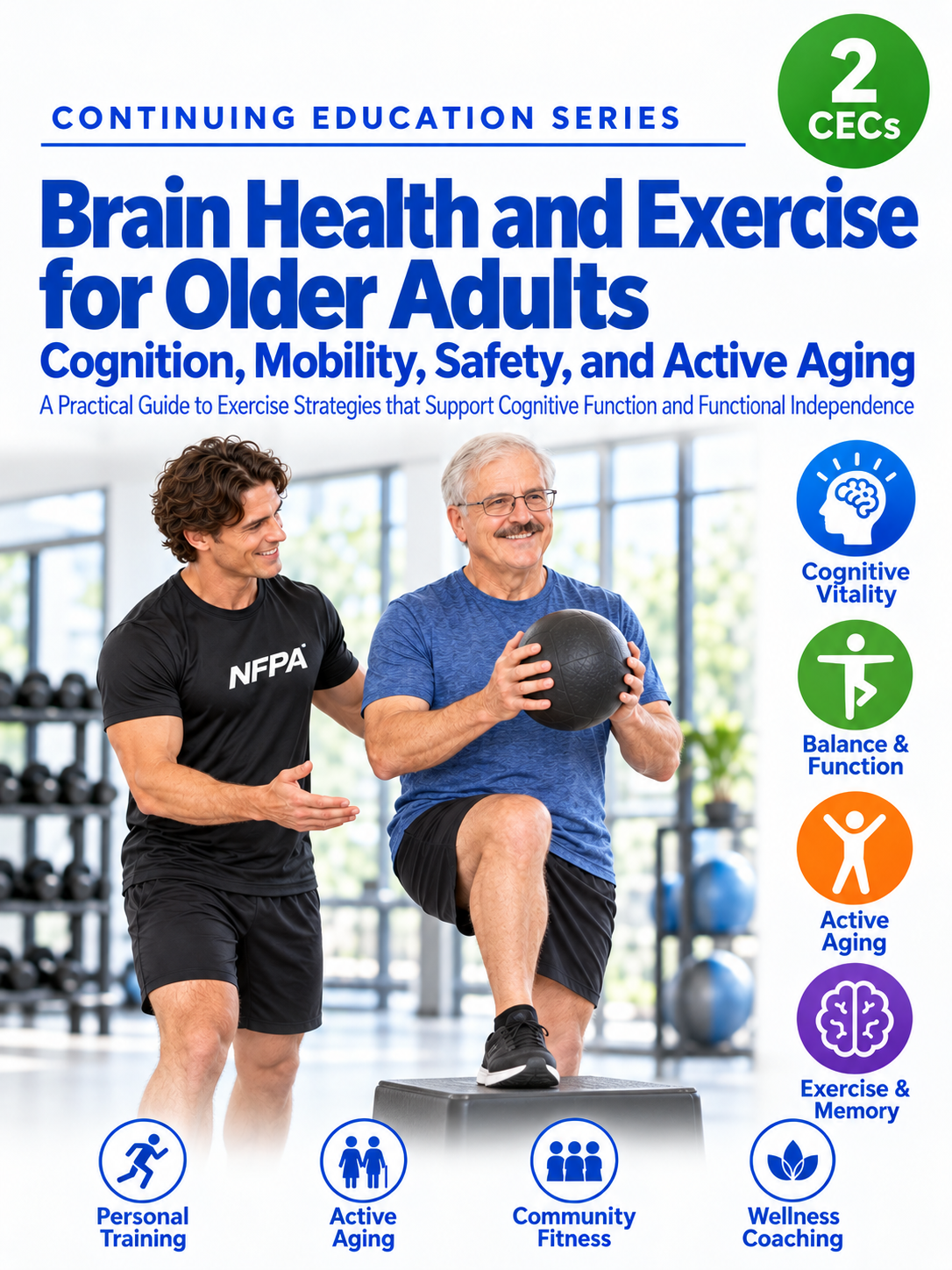
Cognition, Mobility, Safety, and Active Aging
Learn how to use evidence-informed exercise programming to support cognitive health, physical function, balance, motor learning, and independence in older adults.
Brain Health and Exercise for Older Adults is a practical 2-CEC continuing education course exploring the relationship between physical activity, cognitive function, healthy aging, and safe exercise programming.
The course explains how normal aging can influence attention, memory, processing speed, coordination, and motor learning without making dementia an inevitable part of aging. Fitness professionals will examine how aerobic exercise, resistance training, balance activities, and multicomponent programming may support physical and cognitive health.
Special attention is given to dual-task exercise, progressive cognitive-motor challenges, respectful communication, clients with mild cognitive impairment, and recognizing meaningful changes that warrant medical evaluation.
Fitness professionals will learn to build challenging but appropriate programs that support the whole person while maintaining clear professional boundaries.
Topics Include:
Understanding brain health beyond memory
Normal cognitive aging versus dementia
Mild cognitive impairment and exercise participation
Attention, processing speed, working memory, and executive function
Cardiovascular, metabolic, and cerebrovascular health
Neural plasticity and exercise-related brain-health mechanisms
Aerobic exercise and cognitive health
Resistance training and functional independence
Balance, mobility, coordination, and fall-related safety
Multicomponent exercise programming for older adults
Motor learning, repetition, and purposeful movement challenges
Motor-cognitive and motor-motor dual-task training
Understanding dual-task cost and safe progression
Tai chi, dance, walking groups, and social engagement
Developing individualized brain-health fitness programs
Communication strategies for clients with cognitive changes
Programming considerations for mild cognitive impairment
Exercise participation for clients with diagnosed dementia
Recognizing neurological warning signs and emergency situations
Professional scope, referral, and appropriate healthcare coordination
Practical older-adult coaching scenarios
The NFPA Brain Health Programming Process
Course Includes:
2 NFPA Continuing Education Credits
Self-paced PDF continuing education course
10-question Practice Knowledge Check with answer key and explanations
Practical older-adult programming examples, dual-task progressions, and applied coaching scenarios
Course Code: CEC-BH-201
Train the whole person—not simply the muscles.
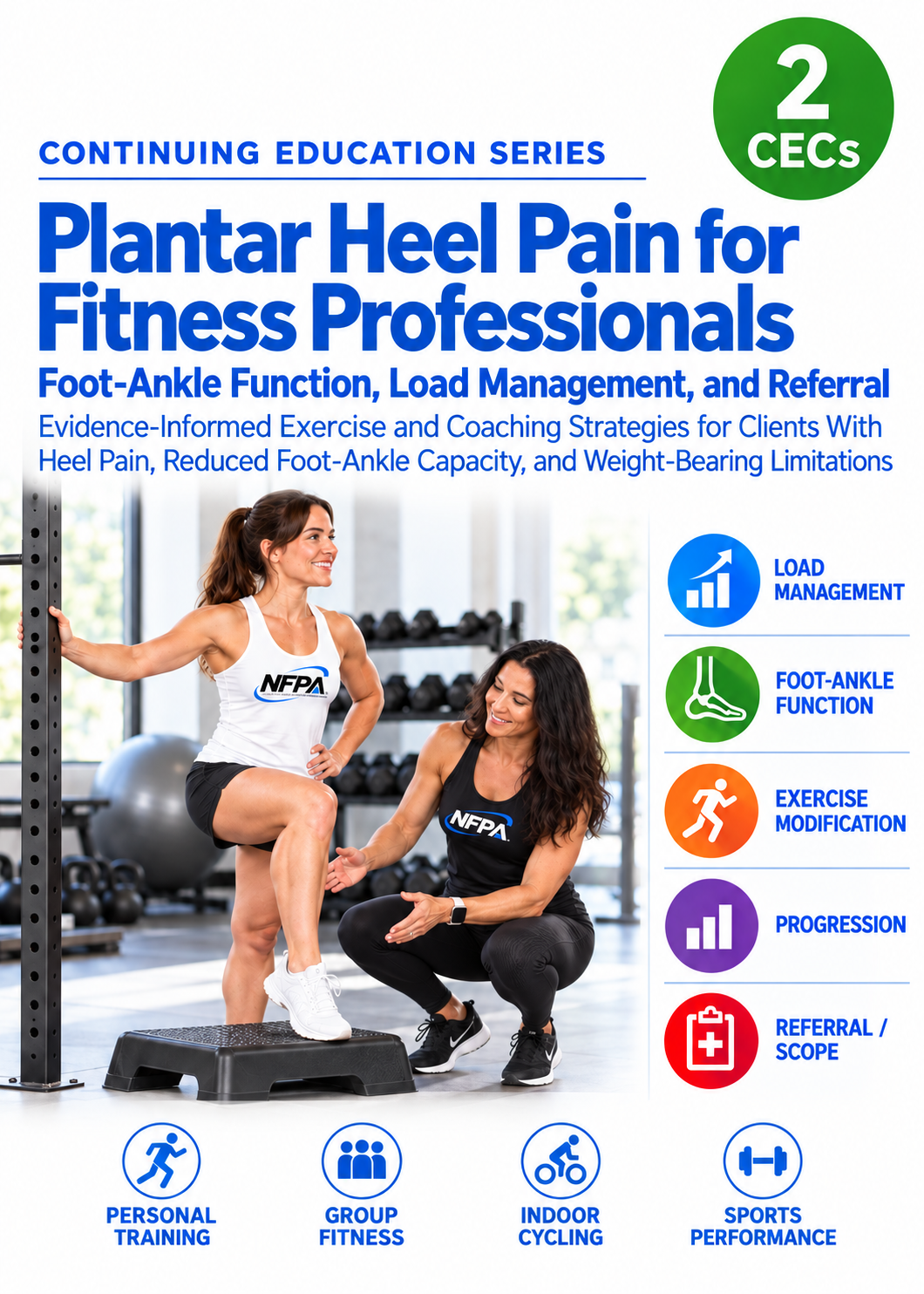
Foot-Ankle Function, Load Management, and Referral
Learn how to help clients experiencing plantar heel pain maintain physical activity, manage exercise demands, and progressively rebuild foot-ankle capacity while respecting professional scope of practice.
Plantar Heel Pain for Fitness Professionals is a practical 2-CEC continuing education course exploring evidence-informed exercise and coaching strategies for clients experiencing heel pain, reduced foot-ankle capacity, and weight-bearing limitations.
The course examines the difference between plantar heel pain and a clinical diagnosis of plantar fasciitis, how walking, running, occupational standing, and resistance training contribute to cumulative loading, and why managing the relationship between physical demand and current capacity is essential.
Fitness professionals will learn how to modify exercise during symptomatic periods, introduce progressive foot and calf strengthening, monitor symptom responses, and gradually restore walking, running, and training tolerance.
Special emphasis is placed on recognizing warning signs, understanding when referral is appropriate, and avoiding diagnosis or clinical treatment outside the fitness professional's scope.
Topics Include:
Understanding plantar heel pain and common symptom patterns
Plantar fasciitis versus other potential causes of heel pain
Plantar fascia function and foot-ankle biomechanics
Gastrocnemius, soleus, Achilles tendon, and intrinsic foot muscles
Ankle dorsiflexion and functional movement
Load management and the relationship between demand and capacity
Walking, running, prolonged standing, and occupational loading
Monitoring symptoms during, after, and the morning following exercise
Avoiding the boom-and-bust cycle of activity and rest
Plantar fascia stretching and calf mobility
Progressive calf and foot-strengthening exercises
Seated, double-leg, single-leg, and loaded calf-raise progressions
Footwear, barefoot activity, taping, orthoses, and night splints
Common myths about plantar heel pain and heel spurs
Modifying squats, lunges, deadlifts, and conditioning exercises
Gradual return-to-walking and return-to-running programs
Recognizing neurological symptoms, suspected stress injuries, and other referral indicators
Professional scope and coordination with healthcare providers
Practical client coaching scenarios
The NFPA Plantar Heel Pain Coaching Process
Course Includes:
2 NFPA Continuing Education Credits
Self-paced PDF continuing education course
10-question Practice Knowledge Check with answer key and explanations
Practical foot-ankle loading progressions, exercise modifications, and applied coaching scenarios
Course Code: CEC-PHP-201
Manage the load—then build the capacity.
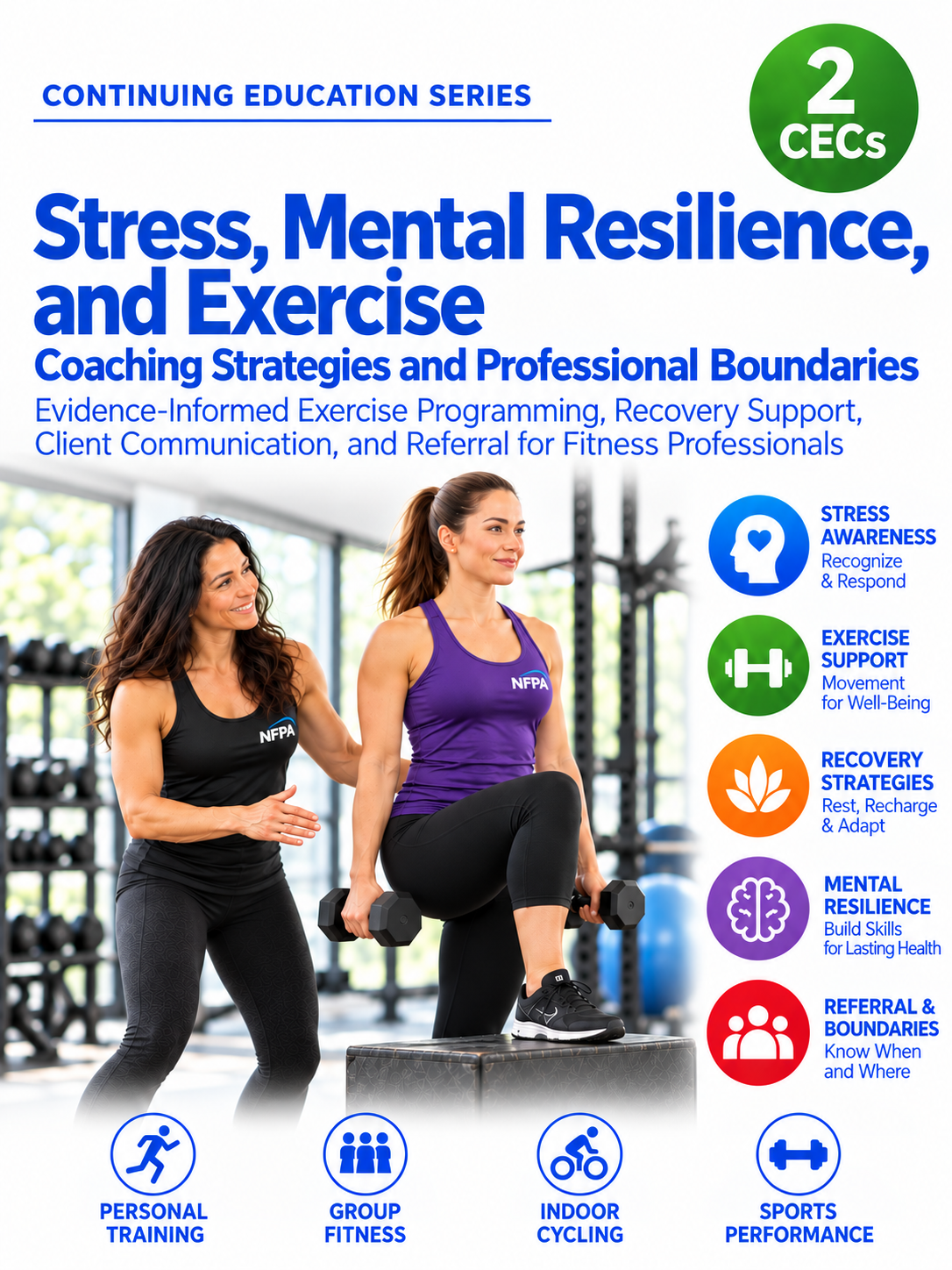
Coaching Strategies and Professional Boundaries
Learn how to help clients use exercise to support stress management, mental well-being, recovery, and resilience while maintaining appropriate professional boundaries.
Stress, Mental Resilience, and Exercise is a practical 2-CEC continuing education course exploring the relationship between physical activity, psychological stress, training readiness, recovery, and client-centered coaching.
The course examines how exercise functions as both a physiological stressor and a potential stress-management tool. Fitness professionals will learn how to recognize the effects of accumulated life stress, adjust exercise programming to match current recovery capacity, and help clients maintain healthy exercise habits during challenging periods.
Special emphasis is placed on professional scope of practice, supportive communication, and recognizing when clients may benefit from referral to qualified healthcare or mental-health professionals.
Topics Include:
Understanding acute and persistent stress
Exercise as both a stressor and a stress-management tool
Psychological resilience and exercise
Exercise, mood, anxiety, and mental well-being
Total life stress and training recovery
Evaluating client readiness and warm-up responses
Modifying exercise volume, intensity, complexity, and frequency
Maintaining training consistency during stressful periods
Walking, resistance training, aerobic exercise, and high-intensity activity
Sleep, nutrition, routine, and social connection
Breathing, mindfulness, and simple regulation strategies
Supportive coaching communication and client autonomy
Overreaching, overtraining, and burnout
Wearable technology, HRV, and recovery scores
Mental-health boundaries and appropriate referral
Building stress-supportive training programs
Practical client coaching scenarios
The NFPA Stress & Resilience Coaching Process
Course Includes:
2 NFPA Continuing Education Credits
Self-paced PDF continuing education course
10-question Practice Knowledge Check with answer key and explanations
Practical exercise-programming modifications and client coaching applications
Course Code: CEC-SMR-201
Exercise should support the client's capacity to handle life—not become another stressor they cannot recover from.
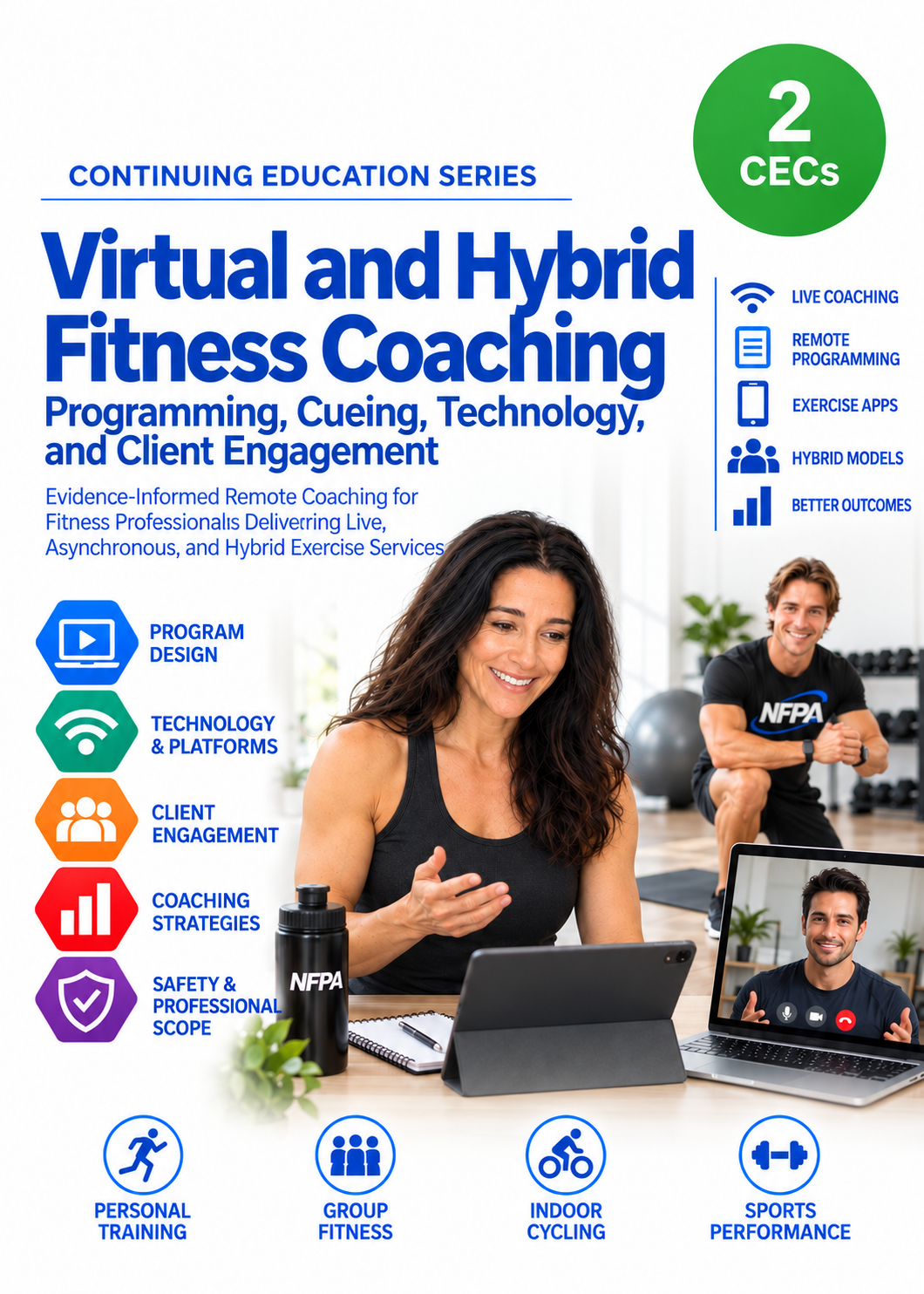
Programming, Cueing, Technology, and Client Engagement
Learn how to deliver safe, effective, and professional fitness coaching through live virtual sessions, remote programming, exercise applications, and hybrid training models.
Virtual and Hybrid Fitness Coaching is a practical 2-CEC continuing education course exploring evidence-informed strategies for delivering fitness services when the trainer and client are not always in the same location.
The course examines how digital coaching changes exercise supervision, program design, communication, client safety, and professional responsibilities. Fitness professionals will learn how to adapt exercise selection, provide effective virtual instruction, manage limited equipment, and structure programs that clients can follow independently.
Special emphasis is placed on camera positioning, concise coaching cues, appropriate use of technology, digital privacy, emergency planning, client engagement, and designing hybrid training systems that combine the strengths of in-person and remote coaching.
Topics Include:
Understanding virtual, asynchronous, and hybrid fitness coaching
Live video coaching versus independent remote programming
Advantages and limitations of digital fitness services
Evaluating client suitability for remote exercise
Preparticipation screening and remote client safety
Assessing home exercise environments and equipment
Establishing emergency procedures for virtual sessions
Exercise selection based on supervision and movement complexity
Progressive overload with limited exercise equipment
Writing effective asynchronous exercise programs
Providing exercise substitutions and clear instructions
Camera positioning for movement observation
Front, side, and angled exercise views
Effective virtual cueing and exercise demonstrations
Managing internet interruptions and connection failures
Reviewing client exercise videos efficiently
Digital privacy, informed consent, and secure client information
Using fitness applications and wearable technology
Interpreting readiness scores and exercise-monitoring data
Client accountability, adherence, and communication boundaries
Building effective hybrid training schedules
Remote group fitness and professional scope considerations
Artificial intelligence and automated coaching tools
Practical remote and hybrid coaching scenarios
The NFPA Virtual and Hybrid Coaching Process
Course Includes:
2 NFPA Continuing Education Credits
Self-paced PDF continuing education course
10-question Practice Knowledge Check with answer key and explanations
Seven practical coaching cases covering remote programming, technology, communication, safety, and professional application
Coach the person—not the platform.

What You Receive
How NFPA CECs Work

Explore Other CEC Values
Invest in your professional growth with NFPA continuing education courses.
Flexible. Relevant. Designed for Real-World Application.