4 CEC

Continuing Education Courses
Build deeper professional knowledge with comprehensive NFPA continuing education courses that combine evidence-informed education with practical fitness application. Each course below provides 4 NFPA Continuing Education Credits and is delivered as a self-paced digital course you can study on your schedule.
Focused Education. Practical Application. Professional Growth.



Choose Your 4 CEC Course
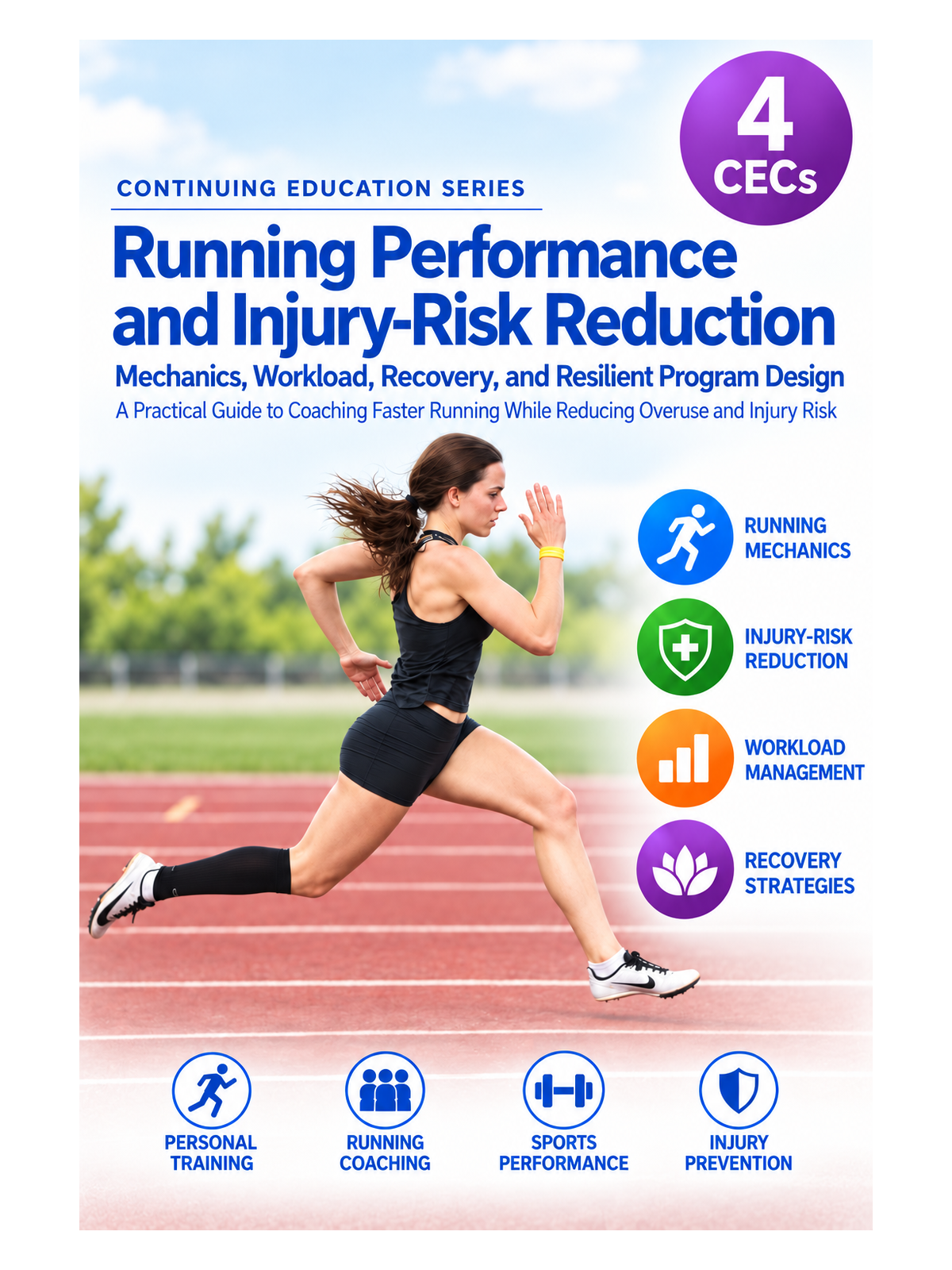
Mechanics, Training Load, Strength, Recovery, and Sustainable Running Programming
A Practical Guide to Improving Running Performance While Managing Training Stress and Reducing Avoidable Injury Risk *
Then paste this full description underneath:
Build faster, stronger, and more durable runners by managing the entire training system—not just mileage.
Running Performance and Injury-Risk Reduction is a comprehensive 4-CEC continuing education course designed to help fitness professionals and running coaches understand the physiological, mechanical, and programming factors that influence running performance and long-term training tolerance.
The course moves beyond simplistic running rules and one-factor explanations for injury. Running performance depends on the interaction of aerobic capacity, threshold, running economy, speed, strength, power, tissue tolerance, recovery, nutrition, mechanics, and training history. Running-related injury is also multifactorial, which means no single cadence, foot strike, shoe type, mileage rule, or exercise can guarantee injury prevention.
The NFPA approach emphasizes six connected principles: build the runner rather than merely accumulating mileage, match training load to current capacity, avoid forcing every runner into one “perfect” form, include meaningful strength training, treat recovery as part of the program, and coach the individual runner rather than the category.
Topics include:
Major determinants of running performance
VO₂max and aerobic capacity
Threshold-related performance
Running economy
Speed reserve and durability
Event-specific running demands
Multifactorial running-injury risk
Capacity versus training demand
Previous injury and training history
Building the runner profile
Running load beyond weekly mileage
Distance, duration, frequency, speed, hills, and surface
Session RPE and training-load context
The limitations of the 10% rule
Running mechanics and individual variation
Cadence and step-rate modification
Step length and overstriding
Vertical oscillation
Trunk position
Hip and knee motion
Pronation
Rearfoot, midfoot, and forefoot striking
Footwear selection and footwear transitions
Treadmill, road, trail, track, uphill, and downhill running
Easy running
Long-run programming
Threshold training
Interval training
Strides and hill training
Running-specific warm-up design
Strength training for runners
Squat, hinge, and unilateral strength patterns
Calf and soleus development
Hamstring, quadriceps, hip, and trunk training
Coordinating running and resistance training
Plyometric training for runners
Recovery, sleep, hydration, and energy availability
Common running symptoms and professional referral
Return-to-running progression
Programming for different types of runners
The NFPA Running Performance Process
Course Includes:
4 NFPA Continuing Education Credits
Self-paced PDF course
Running mechanics and workload education
Practical running-program design
Strength and plyometric programming for runners
Recovery and injury-risk reduction strategies
Return-to-running guidance
Applied coaching examples
Practice Knowledge Check with answer key
Course Code: CEC-RUN-401
Build the runner, not just the mileage. Match training demand to physical capacity and recovery.
Select the topic that best matches your professional interests, client needs, or continuing education goals.
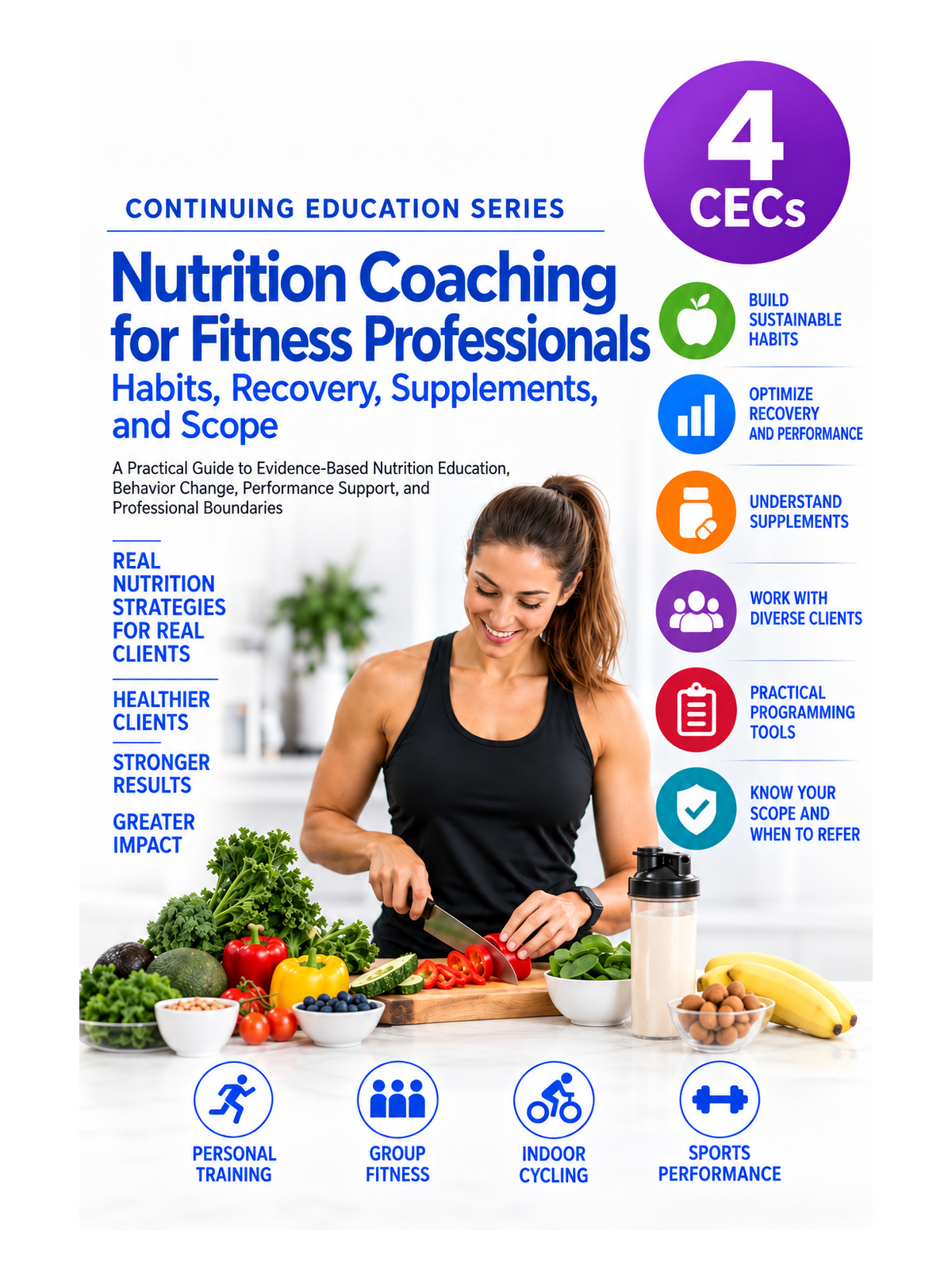
Habits, Recovery, Supplements, and Scope
A Practical Guide to Evidence-Based Nutrition Education, Behavior Change, Performance Support, and Professional Boundaries *
Then paste this full description underneath:
Build the nutrition knowledge and professional judgment needed to help clients make better decisions without crossing into medical nutrition therapy.
Nutrition Coaching for Fitness Professionals is a comprehensive 4-CEC continuing education course designed to help fitness professionals provide practical, evidence-informed nutrition education while maintaining appropriate professional scope.
The course covers nutrition foundations, protein, carbohydrate, dietary fat, hydration, exercise fueling, recovery, body composition, behavior change, supplements, nutrition misinformation, special populations, and referral. Just as importantly, it teaches fitness professionals how to recognize the point at which general nutrition coaching becomes individualized medical nutrition management.
The NFPA approach is built around a simple professional principle:
Educate what you understand. Coach what is appropriate. Refer what exceeds your scope.
The course also emphasizes a practical hierarchy for nutrition coaching: establish adequate food intake and sustainable habits first, add performance nutrition when training demands justify greater precision, and consider supplements only when they solve a legitimate problem.
Topics include:
Professional nutrition scope and referral
General nutrition education versus medical nutrition therapy
Energy balance and sustainable eating patterns
Protein intake and distribution
Carbohydrate for training and recovery
Dietary fat and micronutrients
Plant-based nutrition considerations
Hydration and sweat loss
Pre-, during-, and post-exercise nutrition
Refueling, repairing, and rehydrating
Fat-loss and muscle-gain nutrition
Low energy availability and underfueling
Nutrition behavior change
Meal structure and habit development
Environmental and lifestyle barriers
Supplement evidence and product quality
Creatine monohydrate
Caffeine
Protein supplements
Beta-alanine
Nitrate and beetroot
Sodium bicarbonate
BCAAs and collagen
Supplement safety and third-party testing
Fat burners, detox products, and marketing claims
Common carbohydrate, meal-timing, and fasted-cardio myths
Nutrition considerations for older adults
Plant-based clients
Adolescents
Pregnancy and postpartum
Diabetes and kidney disease scope considerations
Disordered-eating warning signs
Applied nutrition coaching cases
The NFPA Nutrition Coaching Process
Course Includes:
4 NFPA Continuing Education Credits
Self-paced PDF course
Practical nutrition-coaching strategies
Supplement decision-making guidance
Scope and referral guidelines
Applied client coaching cases
Practice Knowledge Check with answer key
Course Code: CEC-NFP-401
Food and habits first. Performance nutrition second. Supplements only when they solve a legitimate problem.
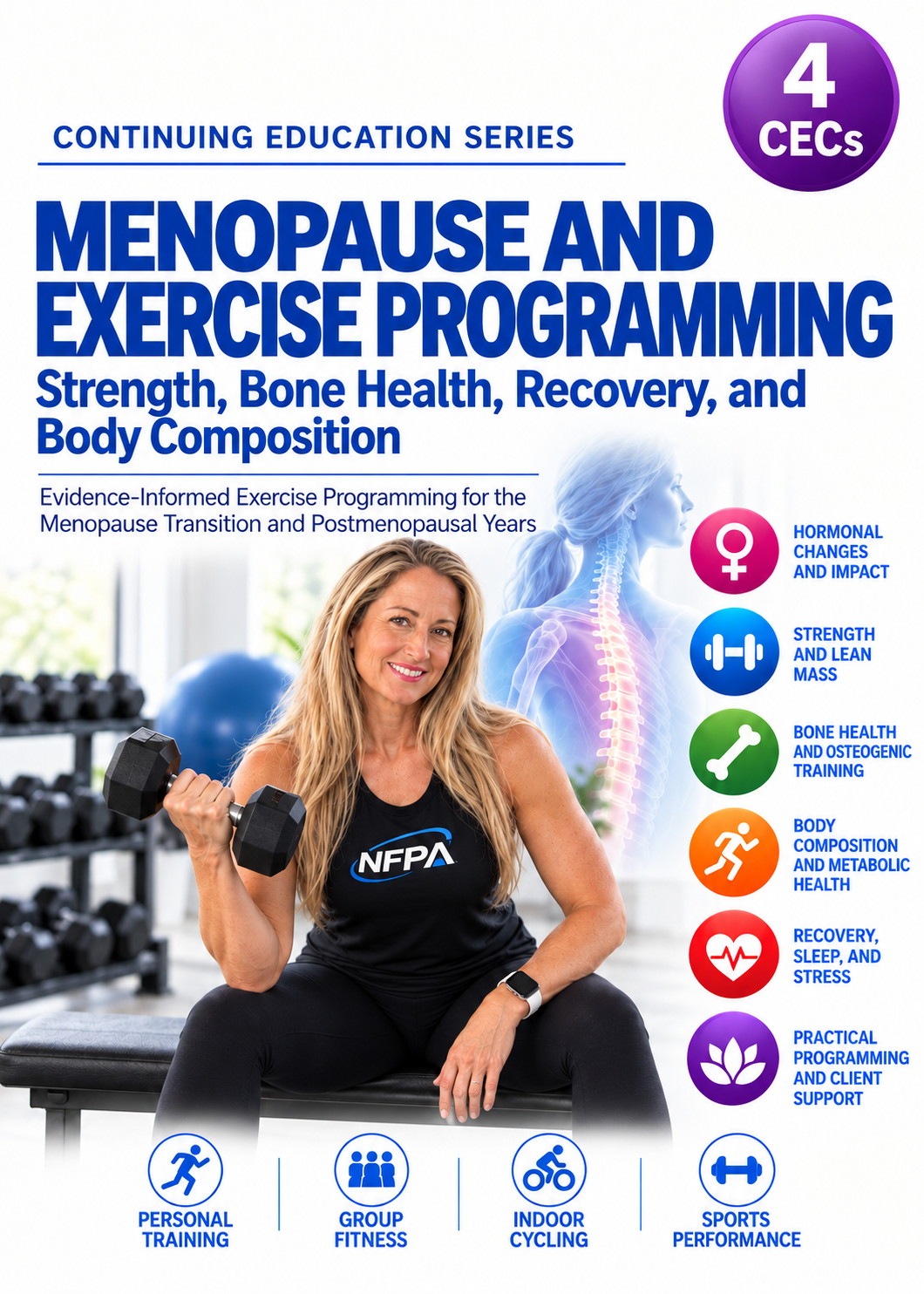
Strength, Bone Health, Recovery, and Body Composition
Learn how to design safe, effective, evidence-informed exercise programs that support muscular strength, bone health, cardiovascular fitness, body composition, recovery, and long-term physical function during the menopause transition and postmenopausal years.
Menopause and Exercise Programming is a practical 4-CEC continuing education course exploring the physiological changes associated with menopause and their implications for individualized fitness programming.
The course examines how hormonal changes, aging, lifestyle, sleep disruption, and health status can influence exercise participation and recovery. Fitness professionals will learn to distinguish established exercise-science principles from misleading claims about menopause, cortisol, metabolism, and specialized hormone-balancing workouts.
Special attention is given to resistance training for preserving muscular strength and lean mass, appropriate skeletal loading for bone health, and combining aerobic exercise with progressive strength training to support cardiometabolic health and physical independence.
Fitness professionals will learn how to adjust training volume, exercise intensity, movement selection, impact exposure, and recovery according to the client's symptoms, experience, health history, and goals.
The course also addresses osteoporosis, pelvic-floor concerns, sleep disruption, fatigue, vasomotor symptoms, cardiovascular risk, and the importance of respecting professional boundaries involving hormone therapy, nutrition, and medical treatment.
Participants will learn practical strategies for developing comprehensive exercise programs that support women throughout midlife and beyond without assuming that menopause makes them physically fragile or requires an entirely different approach to exercise.
Topics Include:
Understanding perimenopause, menopause, and postmenopause
Natural, surgical, and medically induced menopause
Hormonal changes and their effects on physical health
Distinguishing menopause-related changes from normal aging
Vasomotor symptoms, hot flashes, and night sweats
Understanding the evidence for exercise and menopause symptoms
Menopause, muscular strength, and lean mass
Progressive resistance training for midlife women
Strength-training intensity, volume, frequency, and recovery
Muscular hypertrophy and long-term functional independence
Power development and functional movement capacity
Bone remodeling and postmenopausal bone loss
Osteopenia, osteoporosis, and fracture-risk considerations
Weight-bearing exercise and skeletal loading
Resistance training for bone health
Safe impact-training progressions
Balance training and fall-risk reduction
Body composition and fat distribution across menopause
Lean-mass preservation and central adiposity
Weight-neutral exercise goals and client communication
Aerobic exercise and cardiovascular fitness
HIIT, moderate-intensity training, and individualized conditioning
Blood pressure, metabolic health, and cardiovascular considerations
Sleep disruption, fatigue, stress, and exercise recovery
Readiness-based exercise modifications
Training deloads and recovery management
Nutrition considerations for muscle and bone support
Protein, calcium, vitamin D, and general nutrition education
Pelvic-floor symptoms and exercise modifications
Genitourinary health and appropriate referral
Hormone therapy and professional scope of practice
Recognizing medical warning signs during exercise
Individualized programming for novice and experienced clients
Exercise considerations for women with low bone mass
Integrating strength, aerobic exercise, balance, impact, and mobility
Practical menopause-related fitness coaching scenarios
The NFPA Menopause Exercise Programming Process
Course Includes:
4 NFPA Continuing Education Credits
Self-paced PDF continuing education course
20-question Practice Knowledge Check with answer key and explanations
15 practical coaching cases covering menopause symptoms, bone health, body composition, recovery, strength training, and professional referral
Practical resistance-training, cardiovascular, bone-loading, and recovery-programming strategies
Evidence-informed guidance for individualized exercise programming during and after menopause
Course Code: CEC-MEN-401
Preserve muscle. Load bone. Build capacity. Protect recovery. Train the woman in front of you.
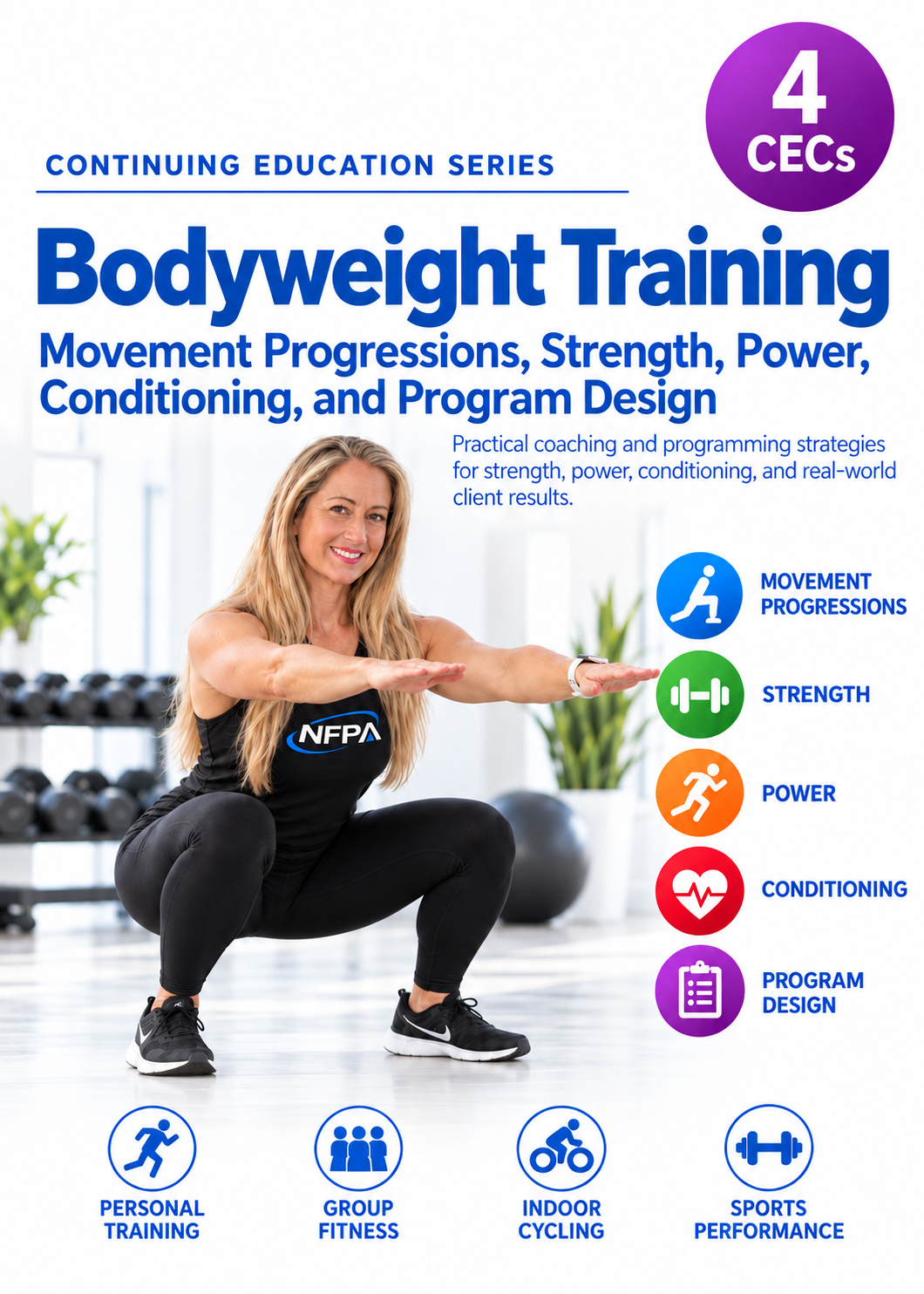
Movement Progressions, Strength, Power, Conditioning, and Program Design
Learn how to build effective bodyweight training programs that develop strength, muscular endurance, power, movement quality, conditioning, and functional fitness through appropriate exercise selection and progressive overload.
Bodyweight Training is a practical 4-CEC continuing education course exploring evidence-informed bodyweight resistance training, exercise techniques, movement progressions, and individualized programming for fitness professionals.
The course examines why bodyweight exercises are not automatically easier than conventional resistance training and how the same exercise can create very different training demands depending on the individual's strength, experience, body proportions, and movement capabilities.
Fitness professionals will learn how leverage, range of motion, assistance, tempo, exercise complexity, base of support, and external resistance can be adjusted to provide an appropriate training stimulus.
Special attention is given to distinguishing exercise difficulty from meaningful overload. Participants will learn why advanced movements are not necessarily superior to simpler exercises and how training methods should be selected according to the desired outcome.
The course also explores bodyweight applications for muscular strength, hypertrophy, endurance, explosive power, plyometrics, cardiovascular conditioning, and functional performance.
Fitness professionals will learn to assess movement capabilities, coach effective exercise variations, manage training volume and recovery, and recognize when external resistance or alternative exercise methods may better serve the client's goals.
Topics Include:
Understanding bodyweight resistance training and calisthenics
The NFPA Bodyweight Training Philosophy
Mechanical loading and exercise difficulty
Progressive overload without conventional weights
Leverage, body position, and mechanical advantage
Base of support and movement stability
Range of motion and exercise progression
Exercise tempo and muscular effort
Repetitions in reserve and training to failure
Recognizing the limitations of bodyweight-only training
Foundational lower-body movement patterns
Squat, sit-to-stand, split squat, and step-up progressions
Hip-hinge patterns, glute bridges, and unilateral exercise
Lunging variations and functional lower-body training
Upper-body pushing and push-up progressions
Upper-body pulling, rows, and assisted pull-ups
Trunk training, bracing, and movement control
Anti-extension, anti-rotation, and lateral stabilization
Programming for muscular strength and hypertrophy
Exercise selection, training volume, and recovery
Muscular endurance and bodyweight work capacity
Circuit training, exercise density, and interval formats
Power development and explosive exercise
Jumping, landing, and plyometric progressions
Differentiating strength, power, and conditioning
Selecting exercises for different fitness objectives
Exercise screening and functional movement observation
Appropriate regression and progression strategies
Bodyweight programming for beginners and older adults
Youth, general-fitness, and athletic training considerations
Home-based and limited-equipment exercise programs
Integrating bodyweight exercises with conventional resistance training
Monitoring exercise performance and client progress
Professional scope of practice and referral
Practical bodyweight training case studies
The NFPA Bodyweight Training Programming Process
Course Includes:
4 NFPA Continuing Education Credits
Self-paced PDF continuing education course
20-question Practice Knowledge Check with answer key and explanations
5 practical case studies covering beginners, advanced exercisers, older adults, athletes, and limited-equipment training
Practical exercise progressions, programming examples, and movement-selection frameworks
Effective bodyweight training is not about choosing the hardest exercise—it is about choosing the right training stimulus for the individual.
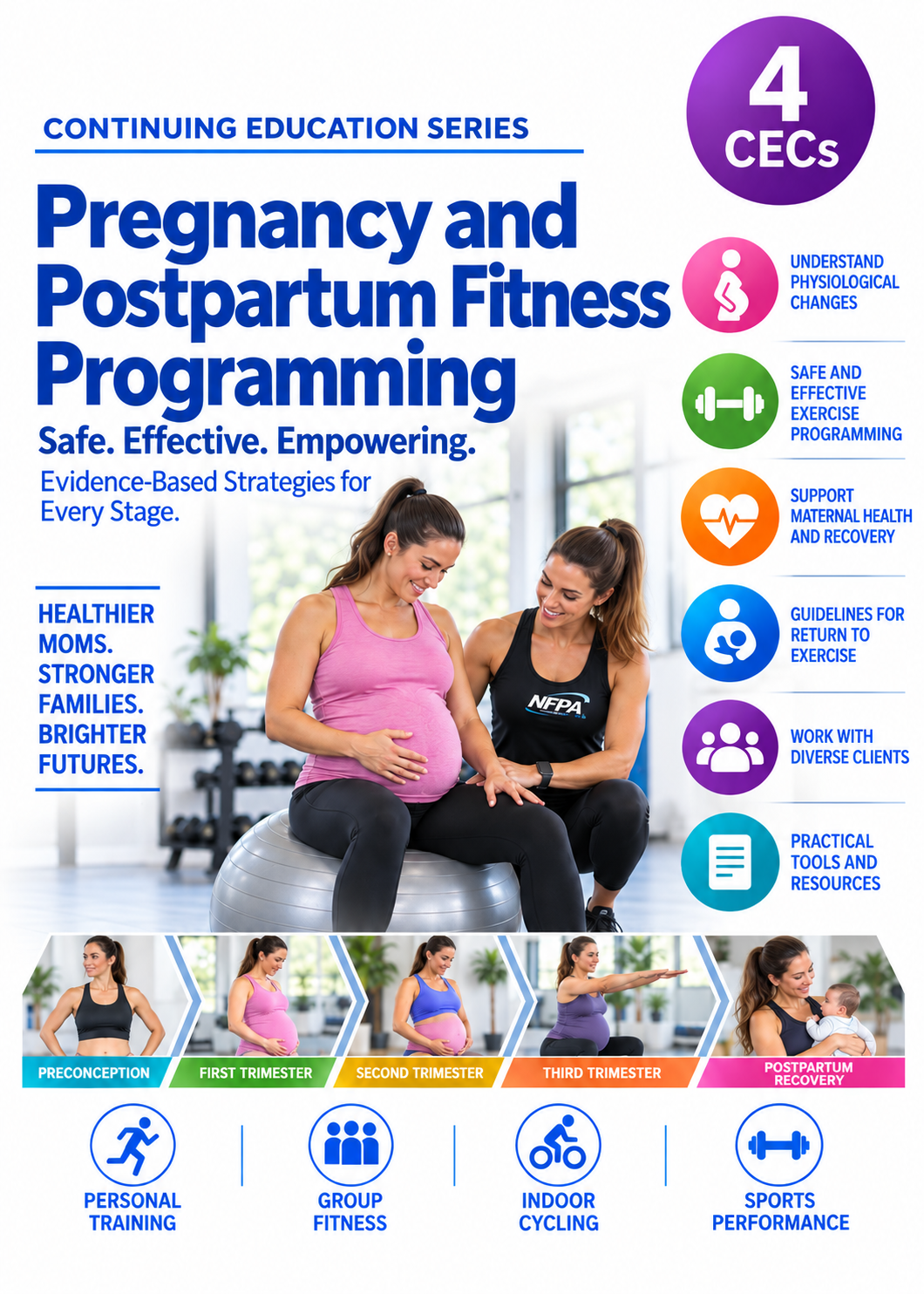
Safe. Effective. Empowering. Evidence-Based Strategies for Every Stage.
Learn how to design safe, effective, and individualized fitness programs for pregnant and postpartum clients while supporting strength, cardiovascular fitness, recovery, functional capacity, and a progressive return to activity.
Pregnancy and Postpartum Fitness Programming is a practical 4-CEC continuing education course exploring evidence-informed prenatal exercise, postpartum recovery, strength and cardiorespiratory training, core and pelvic-floor considerations, exercise modifications, and professional coaching responsibilities.
The course examines why pregnancy is a physiological state rather than an injury. Fitness professionals will learn how appropriately prescribed exercise can support healthy individuals with uncomplicated pregnancies while recognizing the importance of medical status, training history, symptoms, and individual tolerance.
Special attention is given to pregnancy-related cardiovascular and respiratory adaptations, changes in body mechanics and balance, exercise intensity, positional modifications, heat and hydration precautions, and appropriate resistance-training progressions.
Participants will learn how to maintain meaningful strength and aerobic exercise through pregnancy while adapting movement patterns, loading, stability demands, and recovery to the individual.
The course also explores postpartum physical recovery, pelvic-floor function, abdominal-wall changes, cesarean and vaginal delivery considerations, and readiness-based progression toward strength training, cardiovascular conditioning, impact exercise, running, and sport.
Fitness professionals will learn how to recognize warning signs, modify programming appropriately, communicate without fear-based messaging, and collaborate with obstetric providers, pelvic-health physical therapists, and other healthcare professionals.
Topics Include:
Pregnancy as a normal physiological state rather than an injury
Physical activity recommendations during pregnancy and postpartum
Cardiovascular and respiratory adaptations during pregnancy
Changes in body mass, center of gravity, and balance
Exercise intensity using RPE and the Talk Test
Why universal pregnancy heart-rate ceilings are inappropriate
Aerobic exercise and cardiovascular fitness during pregnancy
Resistance training during uncomplicated pregnancy
Strength-training intensity, volume, and exercise selection
Squat, hinge, push, pull, carry, and unilateral exercise modifications
Positional modifications and prolonged supine exercise
Heat exposure, hydration, and environmental considerations
High-risk activities and appropriate exercise avoidance
Core strength, breathing, and pressure management
Pelvic-floor function, coordination, and common misconceptions
Recognizing pelvic-floor symptoms requiring referral
Abdominal-wall changes and diastasis recti
Understanding doming, coning, and functional abdominal training
First-, second-, and third-trimester programming considerations
Training experienced athletes during pregnancy
Prenatal running and resistance-training modifications
Warning signs requiring exercise cessation and medical communication
Recovery following vaginal and cesarean delivery
Early postpartum movement and gradual activity progression
Why medical clearance does not automatically restore fitness capacity
Postpartum aerobic and resistance-training progressions
Rebuilding abdominal strength and functional trunk capacity
Pelvic-floor rehabilitation referral considerations
Return-to-running readiness and walk-run progressions
Progressive return to jumping, impact, and athletic performance
Lactation, hydration, nutrition, and exercise considerations
Sleep disruption, fatigue, and postpartum recovery
Perinatal mental-health concerns and professional referral
Supporting clients without postpartum body-image pressure
Practical prenatal and postpartum exercise programs
Applied pregnancy and postpartum coaching cases
The NFPA Pregnancy and Postpartum Fitness Process
Course Includes:
4 NFPA Continuing Education Credits
Self-paced PDF continuing education course
20-question Practice Knowledge Check with answer key and explanations
4 applied client cases covering experienced prenatal resistance training, pregnant beginners, postpartum return to running, and recovery following cesarean delivery
Practical prenatal and postpartum resistance-training and cardiovascular exercise programs
Evidence-informed exercise modifications, recovery strategies, and professional referral guidelines
Course Code: CEC-PPP-401
During pregnancy, preserve fitness while adapting to change. Postpartum, restore capacity before restoring performance.
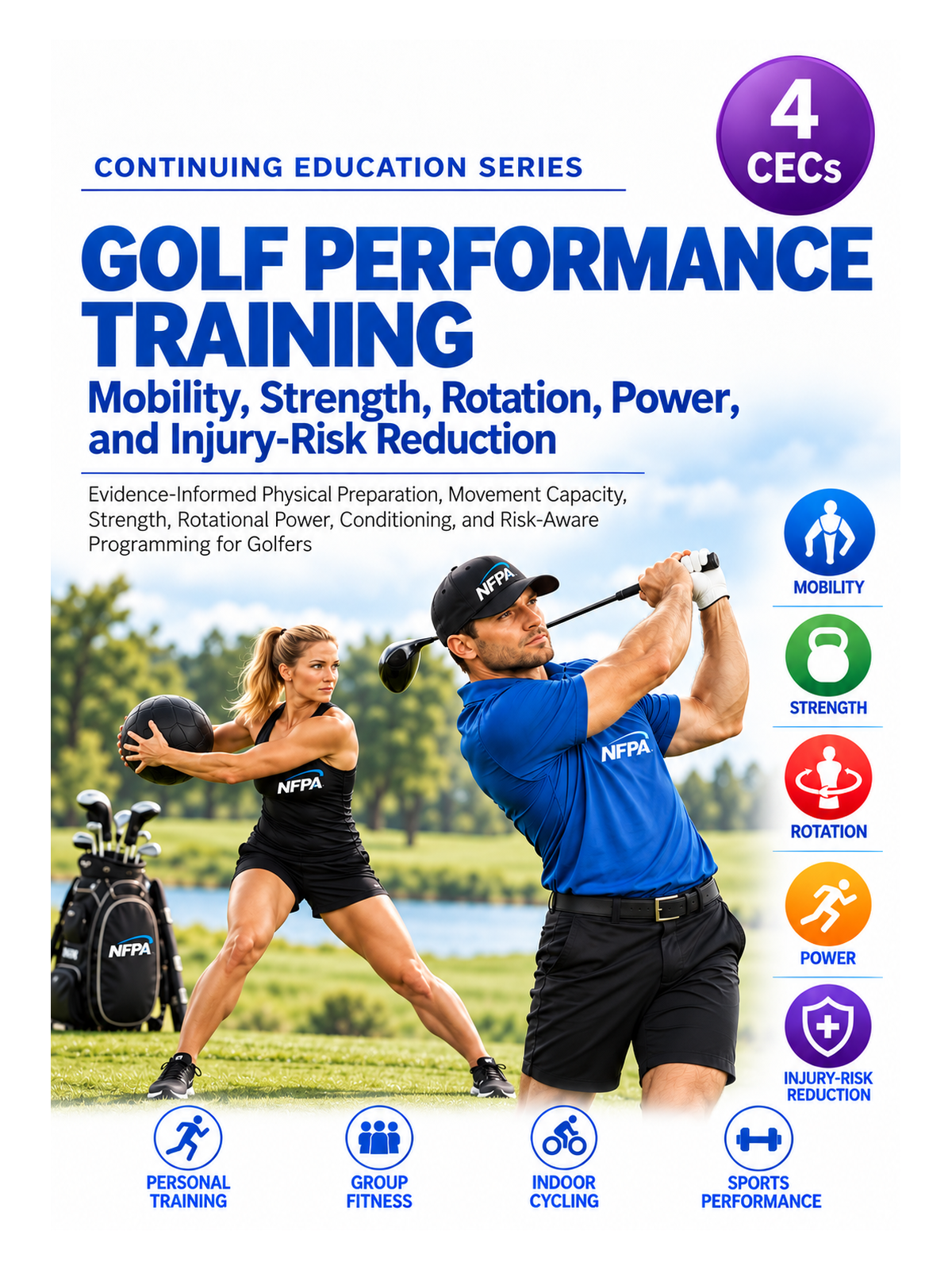
Mobility, Strength, Rotation, Power, and Injury-Risk Reduction
Learn how to develop the physical qualities that support golf performance through evidence-informed strength training, rotational power development, mobility, conditioning, and individualized exercise programming.
Golf Performance Training is a practical 4-CEC continuing education course exploring physical preparation for recreational, competitive, and older golfers.
The course examines how strength, power, mobility, balance, conditioning, and movement capacity contribute to golf performance. Fitness professionals will learn how to develop these physical qualities without confusing exercise programming with technical golf instruction.
Special attention is given to the relationship between strength and clubhead speed, the role of lower-body force production, rotational power development, and the importance of training usable mobility rather than pursuing excessive flexibility.
Fitness professionals will learn how to assess general movement capacity, select appropriate strength exercises, design rotational training progressions, integrate medicine-ball throws and plyometrics, and develop conditioning programs that support walking, practice, and competitive play.
The course also addresses golf-related injury concerns, training workload, recovery, tournament preparation, and the importance of adjusting exercise programming across the off-season, preseason, and competitive season.
Participants will learn how to build comprehensive golf-performance programs while respecting professional boundaries involving golf-swing instruction, injury diagnosis, rehabilitation, and medical referral.
Topics Include:
Understanding the physical demands of golf
Golf fitness versus technical golf instruction
The relationship between physical fitness and clubhead speed
Strength, power, and golf-shot performance
Ground-force production and whole-body coordination
The kinetic chain as a physical-preparation concept
Sport-specific versus sport-imitative training
Assessing golfers' movement capacity and exercise readiness
Hip mobility and controlled rotational movement
Thoracic spine mobility and trunk function
Shoulder mobility, strength, and exercise tolerance
Ankle mobility and lower-body movement
Squat, hinge, and unilateral movement assessment
Balance and single-leg control
Passive mobility versus usable movement capacity
Designing practical golf-fitness assessment batteries
Progressive lower-body resistance training
Upper-body pushing and pulling exercises
Grip, forearm, and loaded-carry training
Core stability, anti-rotation, and rotational control
Programming strength using RPE and repetitions in reserve
Developing rotational power with medicine-ball exercises
Jump training, plyometrics, and rapid-force development
Integrating strength and power for golf performance
Walking endurance and aerobic conditioning
Managing practice volume, physical fatigue, and recovery
Understanding common golf-related injury concerns
Low-back, shoulder, elbow, wrist, hip, and knee considerations
Injury-risk reduction through appropriate physical preparation
Golf fitness for older adults, women, and junior athletes
Programming for recreational and competitive golfers
Off-season strength and power development
Preseason integration and performance preparation
In-season maintenance and workload management
Tournament preparation, travel, and recovery
Equipment-limited golf-performance programming
Monitoring physical progress and adjusting training
Practical golf-performance coaching scenarios
The NFPA Golf Performance Training Process
Course Includes:
4 NFPA Continuing Education Credits
Self-paced PDF continuing education course
20-question Practice Knowledge Check with answer key and explanations
15 practical coaching cases covering golf performance, mobility, strength, training load, pain, injury concerns, and professional referral
Practical strength, mobility, rotational power, and conditioning programs for golfers
Evidence-informed seasonal programming and golf-performance assessment strategies
Course Code: CEC-GPT-401
Build the physical qualities. Let golf practice build the skill.
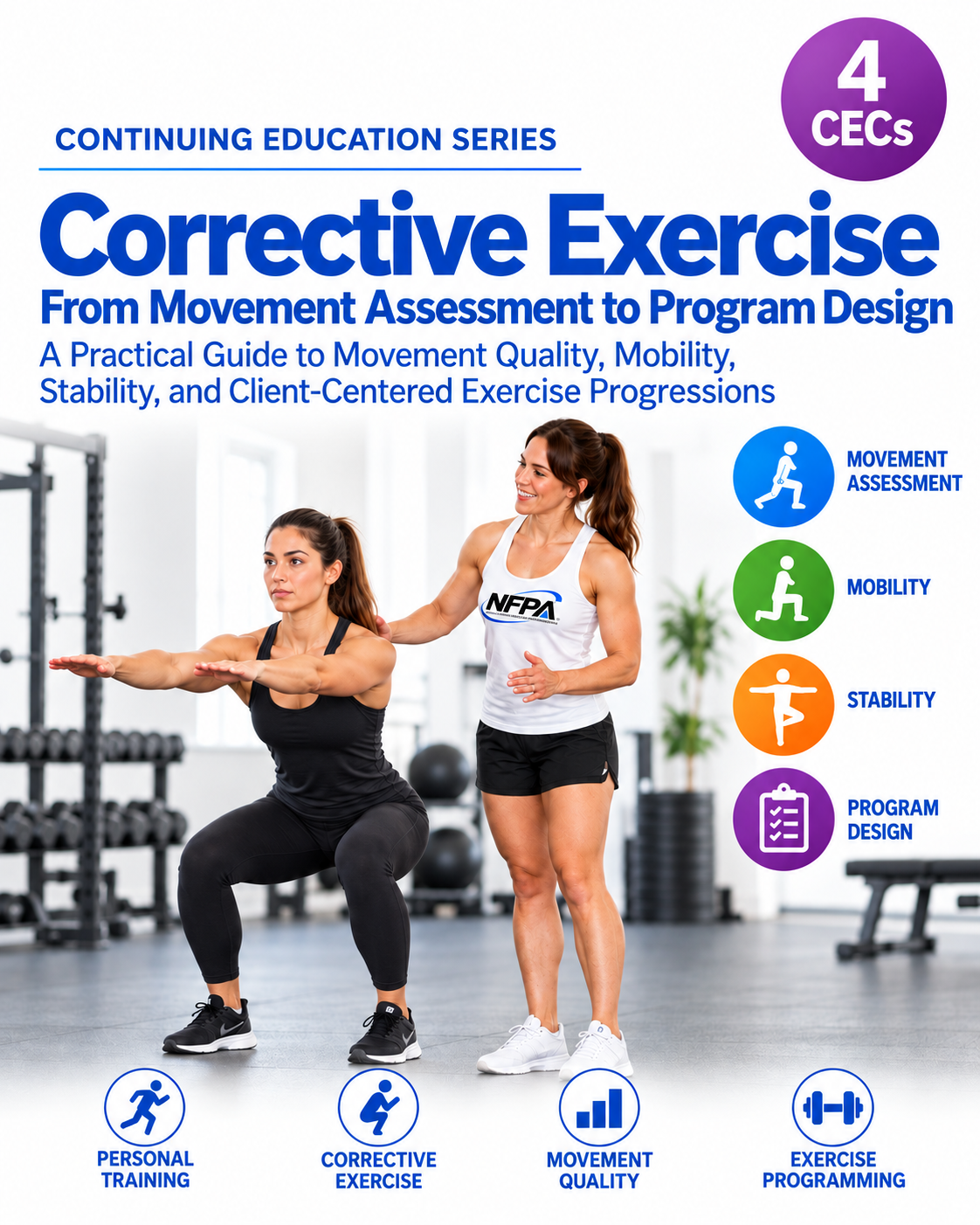
From Movement Assessment to Program Design
Learn how to assess movement, identify meaningful training limitations, and develop effective exercise strategies that improve mobility, stability, strength, coordination, and functional movement capacity.
Corrective Exercise is a practical 4-CEC continuing education course exploring evidence-informed movement assessment, exercise modification, motor control, movement progressions, and individualized programming for fitness professionals.
The course examines corrective exercise as targeted training used to improve movement capacity—not an attempt to identify and repair supposedly defective movement patterns.
Fitness professionals will learn how to observe movement objectively, recognize individual differences, and distinguish limitations involving mobility, strength, balance, coordination, exercise technique, and training experience.
Special attention is given to understanding the appropriate uses and limitations of movement screening. Participants will learn why a single movement assessment cannot reliably predict future injury and why exercise decisions should be based on client goals, symptoms, function, and meaningful training needs.
The course explores practical strategies for assessing squats, hip hinges, lunges, single-leg movements, pushing, pulling, overhead movement, and balance.
Fitness professionals will learn how to apply exercise regressions, progressions, mobility training, strength development, isometric exercises, eccentric loading, movement coaching, and motor-learning principles to improve functional capacity.
The course also emphasizes reassessment, appropriate documentation, professional communication, and recognizing when a client's symptoms require medical evaluation rather than continued fitness intervention.
Topics Include:
Understanding the NFPA corrective exercise philosophy
Corrective exercise as movement-capacity development
Movement observation versus medical diagnosis
Individual movement variability and functional performance
Understanding the limitations of movement screening
Why movement screens cannot reliably predict individual injuries
Client screening, health history, and exercise readiness
Recognizing warning signs and referral concerns
Assessing movement based on client goals
Static posture and its limitations
Squat assessment and movement modifications
Hip-hinge assessment and technique development
Split-squat, lunge, and single-leg movement assessment
Balance assessment and progressive balance training
Upper-body pushing and pulling assessments
Shoulder mechanics and overhead movement
Mobility, flexibility, and usable range of motion
Strength training as a mobility-development strategy
Dynamic mobility, loaded mobility, and stretching
Foam rolling and its appropriate application
Motor control and movement-skill development
Understanding common muscle-activation misconceptions
Core stability, trunk control, and spinal movement
Limitations of the tight-versus-weak model
Posture, muscular imbalance, and corrective exercise myths
Exercise regressions and progressions
Modifying load, range, speed, stability, and complexity
Isometric training and positional control
Eccentric and concentric strength development
Exercise tempo and movement quality
Integrating corrective exercises into normal strength training
Prioritizing assessment findings
Reassessing movement after intervention
Distinguishing immediate improvements from long-term adaptations
Communicating assessment results without fear-based language
Professional documentation and client education
Practical corrective exercise case studies
The NFPA Corrective Exercise Coaching Process
Course Includes:
4 NFPA Continuing Education Credits
Self-paced PDF continuing education course
20-question Practice Knowledge Check with answer key and explanations
10 applied case studies demonstrating movement assessment, exercise modifications, programming decisions, and professional referral
Practical exercise progressions and movement-assessment examples
Evidence-informed strategies for integrating corrective exercise into comprehensive fitness programs
Course Code: CEC-CEX-401
Assess movement capacity. Identify meaningful limitations. Build strength, control, and confidence through purposeful training.
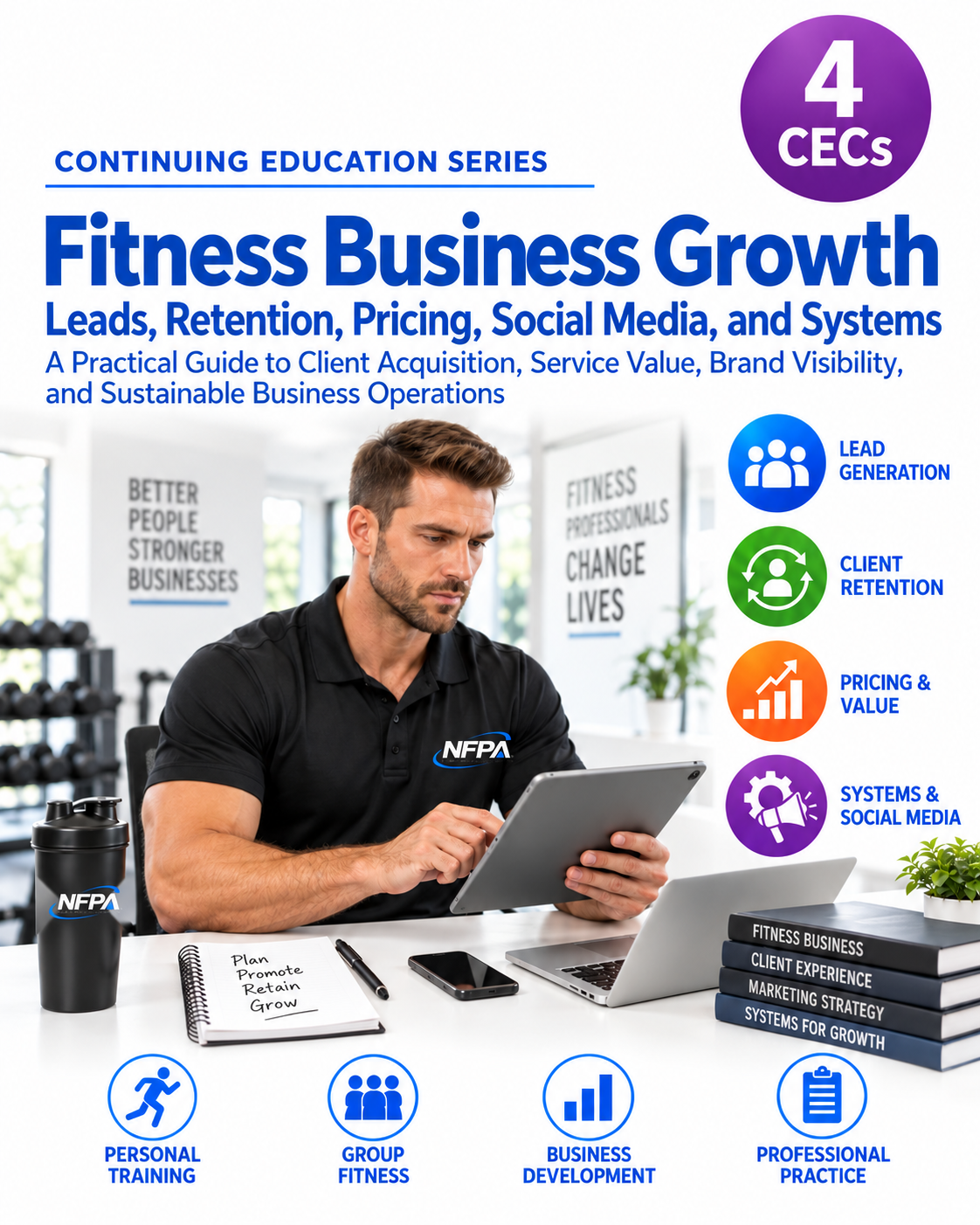
Leads, Retention, Pricing, Social Media, and Systems
Learn how to build a profitable, professional, and sustainable fitness business through strategic pricing, effective client acquisition, improved retention, purposeful marketing, and reliable business systems.
Fitness Business Growth is a practical 4-CEC continuing education course exploring evidence-informed business principles and their application to personal training, group fitness, online coaching, fitness studios, and other professional fitness services.
The course examines why excellent coaching skills alone do not guarantee business success. Fitness professionals will learn how client acquisition, service quality, pricing, onboarding, retention, financial management, marketing, and daily operations work together to create a sustainable business.
Special attention is given to understanding the complete customer journey—from initial awareness and inquiry through consultation, enrollment, onboarding, results, retention, and referrals.
Participants will learn how to identify an appropriate target market, communicate a clear value proposition, develop professional service offers, establish sustainable pricing, and improve consultation and follow-up processes.
The course also explores social-media marketing, ethical advertising, client testimonials, email communication, customer relationship management, and the appropriate use of automation and technology.
Fitness professionals will learn how to evaluate essential business metrics, including revenue, profit, cash flow, customer acquisition cost, client lifetime value, retention, churn, and operational capacity.
The course emphasizes growing a business through professional service, measurable value, consistent systems, and responsible decision-making rather than relying on constant discounts, social-media popularity, or aggressive sales tactics.
Topics Include:
Understanding the NFPA Fitness Business Philosophy
Defining sustainable business growth
Assessing business readiness before increasing marketing
Identifying ideal clients and target markets
Market research and competitive positioning
Creating a clear professional value proposition
Developing understandable fitness-service offers
Communicating service benefits without unrealistic guarantees
Understanding revenue, profit, cash flow, and owner compensation
Fixed, variable, and semi-variable business expenses
Break-even analysis and business sustainability
Establishing appropriate fitness-service pricing
Session packages, memberships, and alternative service models
Pricing according to capacity, costs, and market demand
Understanding effective hourly revenue
Discounting strategies and common pricing mistakes
Lead generation through referrals, websites, search, and social media
Community partnerships and professional referral networks
Developing a structured lead pipeline
Improving inquiry response and consultation booking
Professional consultation and enrollment strategies
Creating ethical and effective follow-up systems
Client onboarding and the first-month experience
Improving client retention and long-term satisfaction
Recognizing early signs of client disengagement
Progress reviews and communicating ongoing service value
Calculating client retention and churn
Understanding customer acquisition cost and lifetime value
Ethical testimonials, reviews, and referral practices
Social-media content strategy and business objectives
Educational content, credibility, trust, and conversion
Effective calls to action and marketing measurement
Email marketing and professional communication
Advertising compliance and commercial email considerations
Scheduling, billing, CRM, and business software
Building standard operating procedures
Appropriate automation and artificial intelligence applications
Protecting client information and business data
Measuring leads, conversions, revenue, profitability, and capacity
Hiring, expanding, and scaling fitness services
Practical fitness-business case applications
The NFPA Fitness Business Growth Process
Course Includes:
4 NFPA Continuing Education Credits
Self-paced PDF continuing education course
20-question Practice Knowledge Check with answer key and explanations
4 detailed business case applications covering pricing, lead conversion, client retention, and discounting
Practical business systems, financial calculations, marketing strategies, and client-management frameworks
Evidence-informed guidance for sustainable fitness-business development
Course Code: CEC-FBG-401
Sustainable growth is a system—not a social-media post.
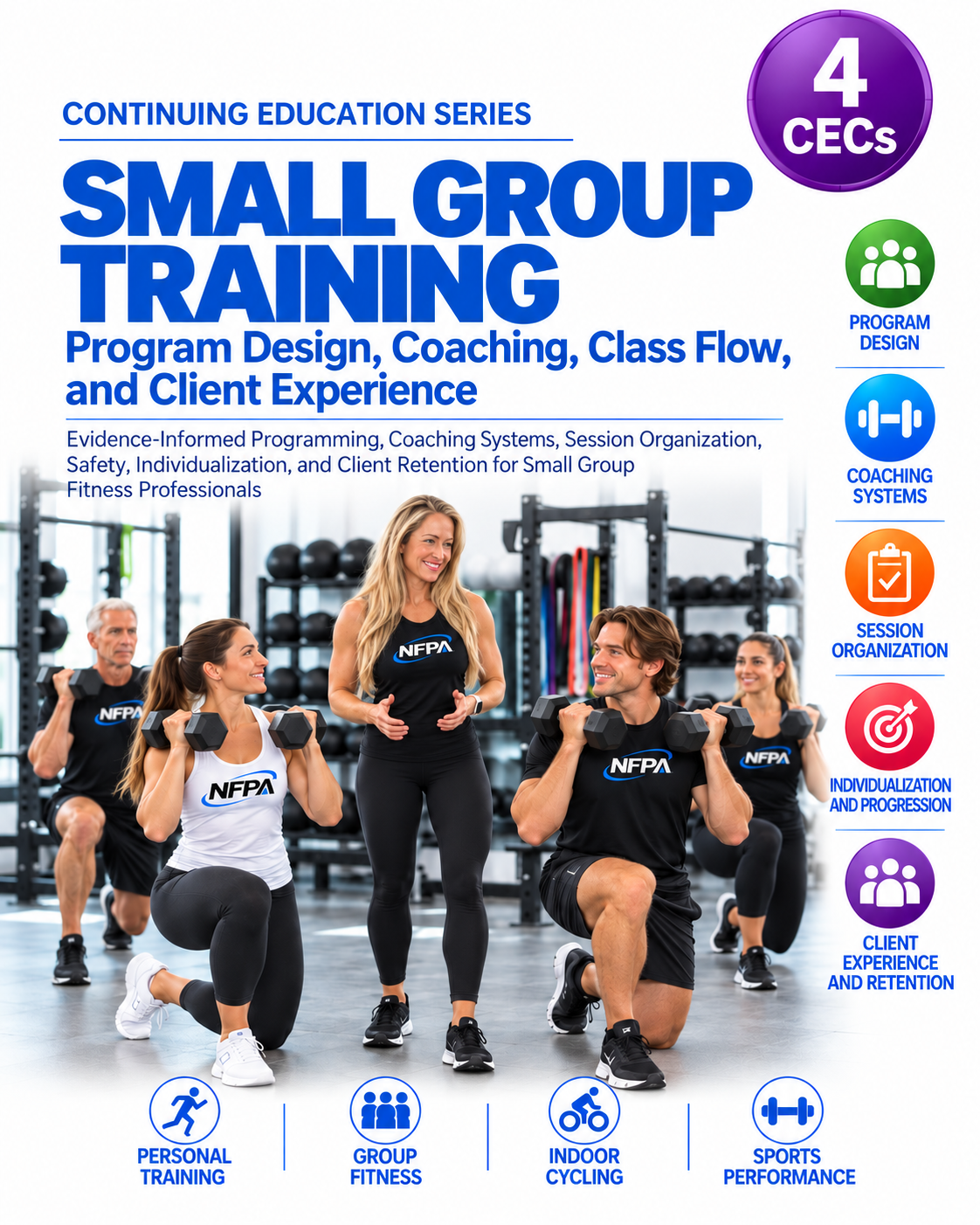
Program Design, Coaching, Class Flow, and Client Experience
Learn how to design, organize, and coach effective small group training programs that combine individualized exercise prescriptions with the motivation, accountability, and energy of a shared training environment.
Small Group Training is a practical 4-CEC continuing education course exploring evidence-informed exercise programming, professional coaching systems, session organization, client safety, and retention strategies for fitness professionals.
The course examines how small group training differs from both one-on-one personal training and traditional group fitness. Fitness professionals will learn why delivering the same workout to several people does not automatically constitute individualized small group training.
Special attention is given to creating shared training objectives while modifying exercise selection, resistance, repetitions, volume, range of motion, tempo, rest, and progression according to individual client needs.
Participants will learn how to screen and place clients appropriately, develop scalable training programs, manage equipment and exercise stations, and maintain effective supervision while coaching multiple people simultaneously.
The course also explores different session structures, trainer positioning, coaching priorities, group dynamics, communication, accountability, and professional client-retention strategies.
Fitness professionals will learn to build organized, progressive, and inclusive small group training experiences that preserve individual attention without sacrificing safety, exercise quality, or meaningful training results.
Topics Include:
Understanding the small group training model
Small group training versus personal training and group fitness
Individualized programming within a shared session
Determining appropriate trainer-to-client ratios
Client screening, intake, and group placement
Evaluating training experience and exercise independence
Goal setting and client readiness
Recognizing clients who require one-on-one training
Designing shared training objectives
Strength, hypertrophy, power, endurance, and conditioning programs
Movement families and exercise progressions
Squat, hinge, push, pull, carry, and trunk training
Individualizing load, repetitions, sets, range, tempo, and rest
Using RPE and repetitions in reserve
Exercise regressions and substitutions
Double progression and structured training blocks
Designing effective 30-, 45-, and 60-minute sessions
Straight sets, supersets, paired sets, circuits, and stations
Equipment management and station organization
Preventing equipment bottlenecks
Safe floor layouts, traffic patterns, and trainer sight lines
Managing transitions and training density
Teaching and demonstrating exercises efficiently
Verbal, visual, and appropriate tactile coaching
Prioritizing safety-critical coaching corrections
Managing fatigue and exercise technique
Coaching multiple participants simultaneously
Emergency response and professional safety considerations
Training beginners and experienced clients together
Small group programming for older adults
Special-population modifications and professional referral
Client motivation, confidence, and self-efficacy
Developing an inclusive group culture
Managing competition, group dynamics, and social interaction
Client accountability and communication
Integrating new participants into established groups
Tracking individual progress and reassessment
Designing four-, eight-, and twelve-week training programs
Small group business organization and client retention
Practical small group training case studies
The NFPA Small Group Training Process
Course Includes:
4 NFPA Continuing Education Credits
Self-paced PDF continuing education course
20-question Practice Knowledge Check with answer key and explanations
15 applied case studies covering individualization, class organization, safety, coaching challenges, group dynamics, and professional practice
Practical introductory, strength, conditioning, and progressive small group programming examples
Evidence-informed strategies for improving client experience, accountability, and retention
Course Code: CEC-SGT-401
Individualize the person. Organize the group. Coach the room.
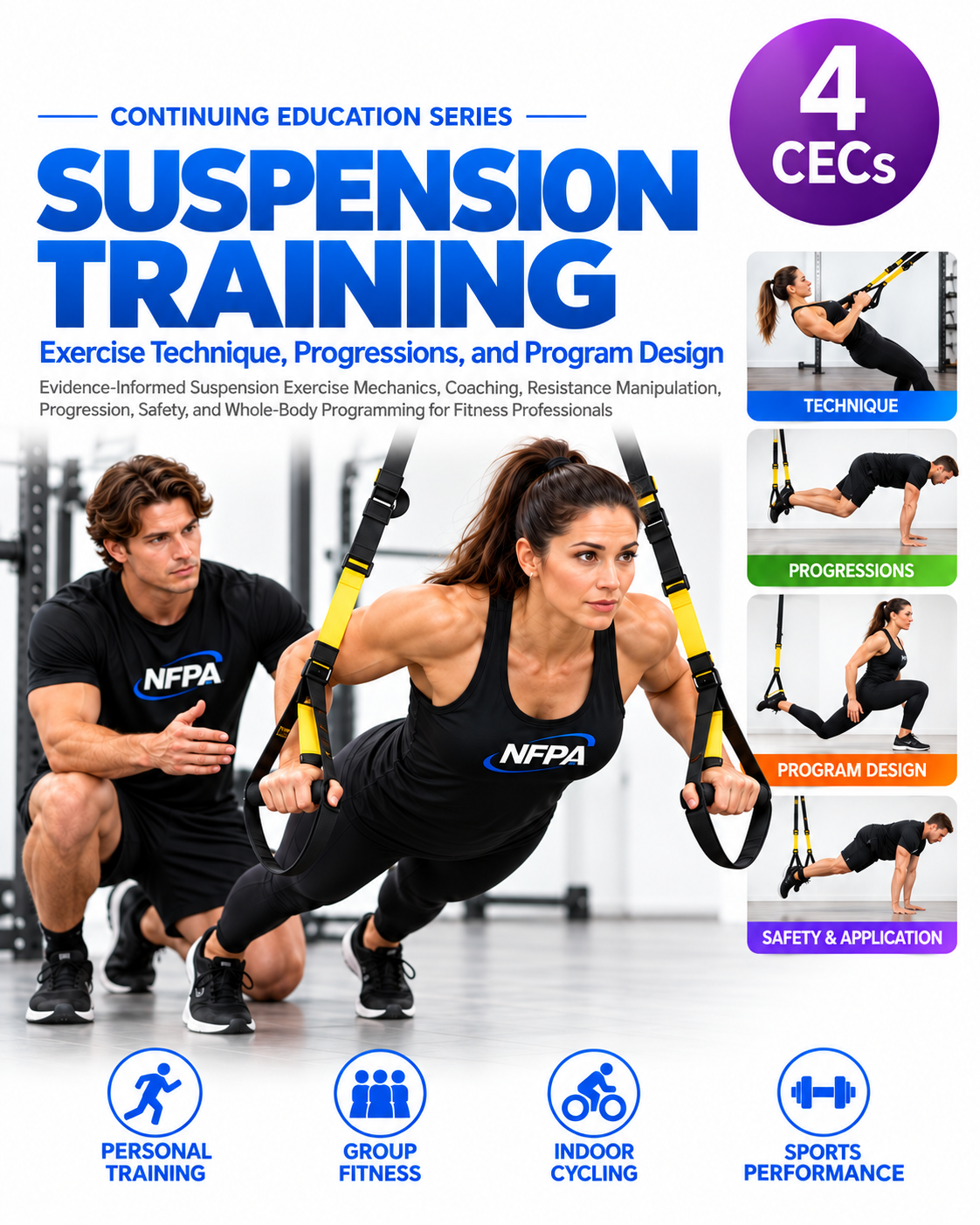
Exercise Technique, Progressions, and Program Design
Learn how to use suspension training systems to develop strength, muscular endurance, movement control, balance, trunk stability, and whole-body conditioning through effective exercise technique and progressive programming.
Suspension Training is a practical 4-CEC continuing education course exploring evidence-informed suspension exercise mechanics, resistance manipulation, professional coaching, exercise progression, and individualized program design.
The course examines how suspension training uses body weight, gravity, leverage, body angle, and adjustable support to create resistance. Fitness professionals will learn why changing a client's body position can substantially alter exercise difficulty without adding conventional external weights.
Special attention is given to understanding instability and its appropriate role in exercise programming. Participants will learn why greater instability does not automatically produce greater strength, muscular development, or functional improvement.
Fitness professionals will explore proper suspension equipment setup, anchor-point safety, controlled movement technique, and safe entry and exit procedures.
The course provides practical instruction for suspension squats, lunges, rows, presses, hamstring curls, planks, trunk exercises, and integrated full-body movements.
Participants will learn how to adjust body angle, base of support, lever length, range of motion, tempo, strap positioning, and training volume to develop progressive exercise programs.
The course also addresses suspension training for beginners, older adults, general fitness clients, athletes, and group exercise environments while maintaining appropriate professional boundaries.
Topics Include:
Understanding suspension training as resistance exercise
Gravity, body weight, leverage, and mechanical loading
How body angle changes resistance
Center of mass and base of support
Strap length, positioning, and exercise difficulty
Understanding instability and muscular activation
Suspension training versus traditional resistance exercise
Equipment inspection and secure anchor points
Strap tension, handle control, and safe body positioning
Safe exercise entry and exit procedures
Foundational movement technique and coaching cues
Suspension-supported squats and squat progressions
Split squats, lunges, and unilateral lower-body training
Assisted single-leg squat progressions
Rear-foot-suspended split squats
Hip-hinge exercises and posterior-chain development
Suspended bridges and hamstring curls
Upper-body pulling and suspension row progressions
Single-arm rows and rotational variations
Reverse flies, Y raises, and biceps exercises
Standing suspension chest presses
Suspended push-up progressions
Single-arm pressing and triceps exercises
Trunk control and anti-extension training
Suspended planks, knee tucks, and mountain climbers
Body saw, pike, and advanced trunk exercises
Anti-rotation and controlled rotational movements
Progressive overload using body angle and leverage
Training intensity, RPE, and repetitions in reserve
Programming for strength and muscular hypertrophy
Muscular endurance and conditioning circuits
Balance, coordination, and power development
Suspension training for beginners and older adults
Exercise modifications for selected special populations
Integrating suspension training with free weights and machines
Suspension training for athletes and sports performance
Organizing suspension training in group settings
Equipment safety, exercise monitoring, and professional referral
Practical suspension-training coaching scenarios
The NFPA Suspension Training Programming Process
Course Includes:
4 NFPA Continuing Education Credits
Self-paced PDF continuing education course
20-question Practice Knowledge Check with answer key and explanations
15 applied coaching cases involving exercise technique, progression, training difficulty, client safety, and practical programming
Suspension exercise progressions for upper-body, lower-body, and trunk training
Practical full-body, conditioning, and integrated resistance-training program examples
Evidence-informed guidance for safe equipment use and resistance manipulation
Control the position. Control the resistance. Build the movement. Progress the load.
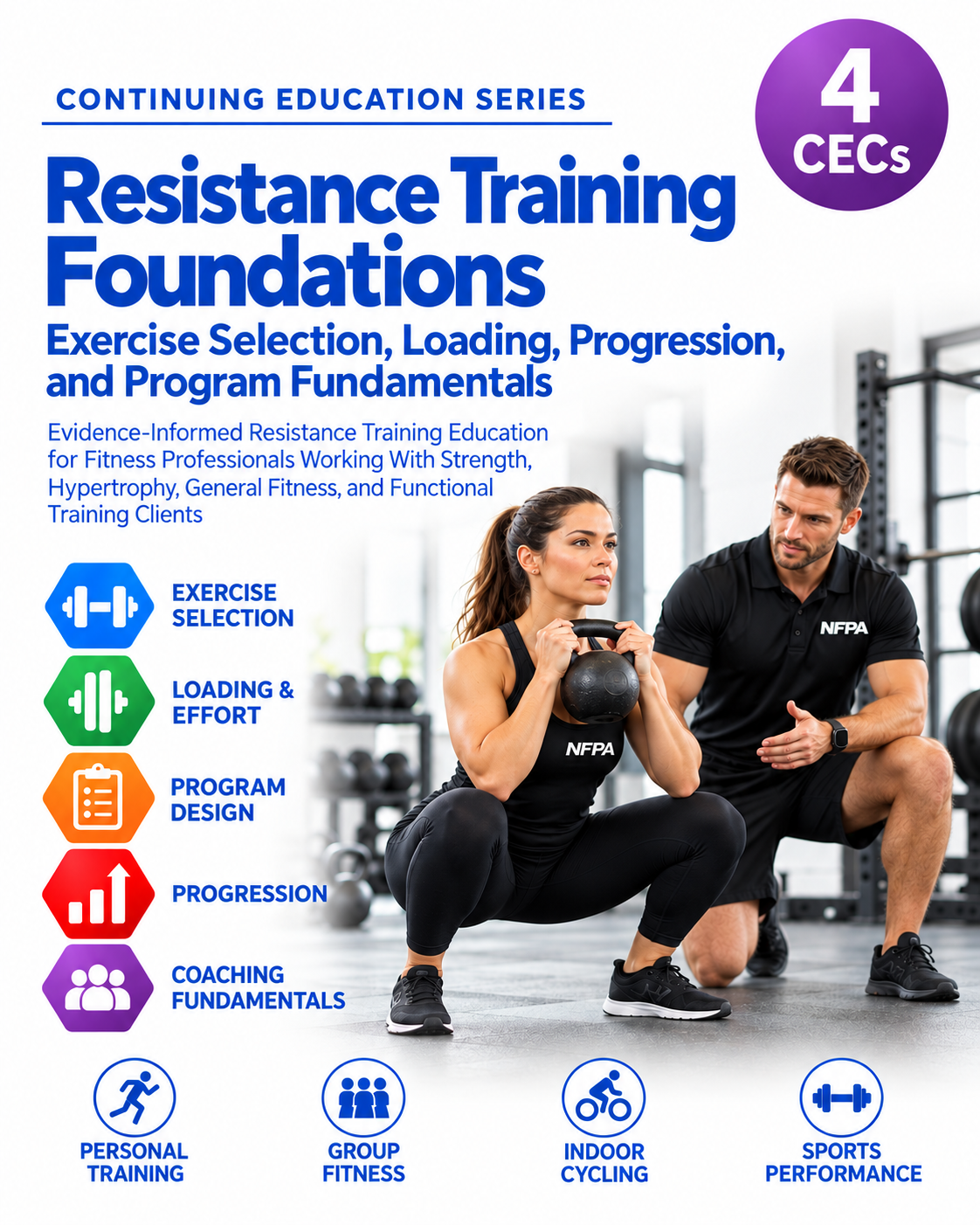
Exercise Selection, Loading, Progression, and Program Fundamentals
Learn how to design effective resistance-training programs using evidence-informed principles of exercise selection, training intensity, loading, volume, recovery, and progressive overload.
Resistance Training Foundations is a practical 4-CEC continuing education course exploring the essential principles of resistance exercise for fitness professionals working with clients pursuing strength, muscular hypertrophy, endurance, power, physical function, and general fitness.
The course examines how resistance training produces neurological, muscular, and structural adaptations, and why effective programming begins with the client's goals rather than a predetermined exercise or training method.
Fitness professionals will learn how to select appropriate exercises, choose effective resistance levels, interpret repetitions in reserve (RIR), and organize sets, repetitions, rest periods, training frequency, and exercise order.
Special attention is given to distinguishing meaningful progressive overload from simply making workouts harder. The course explains why adding weight, volume, complexity, fatigue, or exercise variety is not automatically better.
Participants will learn how to compare free weights, machines, cables, bands, and bodyweight exercises while selecting equipment and movement patterns according to individual needs.
The course also addresses exercise technique, movement variability, warm-up strategies, recovery management, training plateaus, program adjustments, and professional scope of practice.
Fitness professionals will gain practical strategies for developing structured, progressive, repeatable, and individualized resistance-training programs.
Topics Include:
Understanding the NFPA Resistance Training Philosophy
Neurological adaptations to resistance training
Muscular hypertrophy and structural adaptations
Connective tissue, tendon, and bone-loading considerations
Strength, hypertrophy, muscular endurance, and power development
Establishing training goals before selecting exercises
General fitness versus sport-specific resistance training
Movement-pattern-based exercise selection
Squat, hinge, push, pull, unilateral, and trunk exercises
Multi-joint versus single-joint resistance exercises
Exercise substitutions that preserve the training objective
Machines, free weights, cables, resistance bands, and bodyweight training
Individual anatomy and movement-technique variation
Appropriate range of motion and exercise tolerance
Resistance loading and percentage-based programming
One-repetition maximum and repetition maximum concepts
Understanding repetition ranges and their limitations
Rating of Perceived Exertion (RPE)
Repetitions in Reserve (RIR)
Training proximity to muscular failure
Technical failure and movement standards
Sets, repetitions, and productive training volume
Weekly training frequency and training distribution
Rest intervals for strength, hypertrophy, and endurance
Exercise order and training priorities
Effective warm-up and exercise preparation
Eccentric, concentric, and isometric muscle actions
Exercise tempo and movement speed
Progressive overload through load, repetitions, volume, and range
Double progression and structured loading strategies
Exercise regression and progression
Training consistency and exercise variation
Monitoring performance, fatigue, and recovery
Recognizing when more training is not the solution
Constructing two-day, three-day, and split resistance-training programs
Individualized training for beginners and experienced clients
Practical resistance-training coaching case studies
Professional scope of practice and referral
The NFPA Resistance Training Process
Course Includes:
4 NFPA Continuing Education Credits
Self-paced PDF continuing education course
20-question Practice Knowledge Check with answer key and explanations
3 applied coaching case studies addressing beginner training, exercise variation, and managing training plateaus
Practical resistance-training program examples and exercise-selection frameworks
Evidence-informed guidance for loading, progressive overload, recovery, and individualized program design
Course Code: CEC-RTF-401
Choose the goal. Select the exercise. Apply the right dose. Monitor the response. Progress when earned.
What You Receive

How NFPA CECs Work

Explore Other CEC Values
Invest in your professional growth with NFPA continuing education courses.
Flexible. Relevant. Designed for Real-World Application.